Desiderius Erasmus Quotes
In the kingdom of the blind, the one-eyed man is king.
Erasmus, Desiderius. Adagia. 1500.

Other cultures had similar proverbs and sayings: See {47199} and {367292}.


The Bank of the Untied States was not a government entity. It was a privately owned. Jackson arranged its demise. See {630653}


Cyrus chose war. But Tomyris and the Massagetai, won and Cyrus was killed in the battle. The famous painter, Rubens, painted the scene of the head of Cyrus being brought to Queen Tomyris.

Bodin was advocating the release of the Cambodian King.

This quotation is of historical significance because it is a source, in addition to the Bible, about the fact that the kingdom of Israel existed and was in conflict with the Moabites. Politically it is important currently because a few of the modern Arab leaders have claimed that there was never a Jewish Kingdom in the region and therefore the Jews do not have a claim on any of the land of Palestine. This is strong evidence that they are wrong. Omri was the 6th King of Israel and his son, Ahab, the 7th. A stele is an ancient stone with writing carved on it. The picture is of the Mesha Stele which today is in the Louvre Museum in Paris.

Many social scientists believe that this is one of the reason for so much racism amongst the lower class whites. If blacks are “below” them, the poor whites have power and are not at the bottom of the sociological pyramid of society. To many this is better than being better off themselves but starring the bottom with the Negroes.

He was writing about America and many of the industrial democracies who at the time, as a result of globalziation, technology, government action and inaction, and other factors, had gone through a 30 year period of increasing disparities.


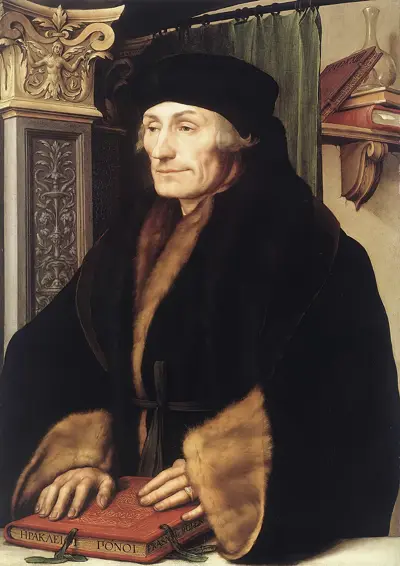
Desiderius Erasmus Roterodamus was a Dutch philosopher and Christian scholar who is widely considered to have been one of the greatest scholars of the northern Renaissance. As a Catholic priest, Erasmus was an important figure in classical scholarship who wrote in a pure Latin style. Among humanists he enjoyed the sobriquet "Prince of the Humanists", and has been called "the crowning glory of the Christian humanists". Using humanist techniques for working on texts, he prepared important new Latin and Greek editions of the New Testament, which raised questions that would be influential in the Protestant Reformation and Catholic Counter-Reformation. He also wrote On Free Will, In Praise of Folly, Handbook of a Christian Knight, On Civility in Children, Copia: Foundations of the Abundant Style, Julius Exclusus, and many other works.
