Deborah E. Lipstadt Quotes
In the 1980s, when the Justice Department began to hunt war criminals who had lied in order to enter this country, both agencies actively obstructed the investigations. They were also protected by White House officials such as Pat Buchanan...
the CIA and the FBI This was not the only time where the CIA and the FBI impeded investigations of serious criminals. Both for example withheld evidence and lied to the Warren Commission investigating the Assassination of John F. Kennedy. The FBI for years helped Southern Law Enforcement officials cover up their and other racial murders and assaults. The CIA had a history of lying to a number of presidents. Each time a reorganization and house cleaning promised to change the agency, but it only works for a while. In the case of the Nazis, it started with our intelligence agencies trying to bring Nazi and Japanese scientists who had committed war crimes to the U. S. to help develop weapons against the Russians, who were also lying to their own people and bringing them to Russia to develop weapons for use against the West. Then Nazi spymasters were brought over and soon, any Nazi War criminal who would claim that he and information about the Communists of Eastern Europe or Russia. Finally, it was lower level Nazi concentration camp guards who had murdered inmates. At that time the intelligence agencies did not want American knowing that many war criminals were living well in the United States even though they were often wanted for crimes in Germany of other European countries. So they preferred that the investigations cease and the media not focus on the problem. There is no evidence that President Reagan knew about the investigation obstructions, however his assistant Pat Buchanan had a history of trying to stop of delay the deportation of Nazi War criminals who had lied on their applications to enter the United States. Many analysts noted a tendency toward anti-semitism in his personal and public life, and he was particularly unconcerned when the victims of the war crimes had been Russians or other European communists.
Deborah E. Lipstadt, Historian & Holocaust Scholar, The Nazis Next Door, 2014
Sourced by: Eigen's Political and Historical Quotations

The assassination was attempted in 1944 and after its failure, he was shot be a firing squad.
The non-violent resistance tactics of the White Rose were so threatening to the Nazi German regime that Sophia and other members were executed by guillotine beheading as a particularly harsh example. The graphic is a postage stamp that Germany has issued in her honor.


Turkey, under the control of the triumvirate of the 3 Young Turks had massacred almost all of the Armenian population in the area claimed by Turkey. At the end of WWI, there were many demands that those who ordered the policy of a Turkish genocide and those who carried it out by brought to justice—tried and punished. The Sultan had done little if anything to stop the slaughters although he was very weak, Turkey under the Young Turks had also picked the wrong side and allied with the Germans. The Sultan and his Grand Vizier were trying to pick up the pieces and maintain the Ottoman Empire as best they could despite they the fact that they lost control of much of their vast territory. At the Paris Peace Conference, the Grand Vizier virtually admitted the crimes and committed the Turkish government to determining the guilty and bringing them to justice. He actually had 50 of the worst offenders arrested (See {620595}.). However, there were a few tried and one governor of a province was hanged and a few others received short jail sentences. Talaat, the worst of The Young Turks regarding the genocide, escaped to Germany. But he was tracked by a surviving Armenian who assassinated Talaat. The assassin was acquitted by a sympathetic German court which ruled that the extermination of the assassin’s family had been so traumatic that temporary insanity relieved the assassin of criminal responsibility.

Eichmann had been responsible for the logistics of murdering most of the over 6 million civilians in WWII. With the aid of pro Nazis in South America he had been hiding there from the allies and justice. Israeli agents located him, kidnapped him, and transported him to Israel where he was tried and hung for crimes against humanity.


The inoming President was meeting with and getting briefed by the Director of National Intelligenc, James Clapper and this is the word he used to descrive the American Intelligence Agencies.

See {642341} for the CIA role in obstructing the Warren Commission investigation. The FBI also withheld evidence about their contacts with Oswald. The investigators for the Commission only came from the two agencies that had much to hide and who lied to the commission.

He was explaining his reasons for resigning in 2005 from the number two position in the Justice Department. The George W. Bush administration had implemented a program of secret wiretapping and surveillance of American citizens in America which required the authorization of the Justice Department which had determined that the program as it was being implemented violated the law. The Attorney General was ill in the hospital but had told Comey that he would not sign the authorization. The White House then pressured Comey to sign and he refused, and in a similar replay of the Watergate “Saturday Night Massacre”, the number three man at Justice would have been ordered to sign. His resignation convinced President Bush to alter the program to take account of the Justice Department objections.
Oswald was the assassin of President John F. Kennedy.
The Germans had just passed a law making it illegal for a Jew to work as a teacher, professor, government official, scientist, or researcher. Szilard, a Jewish Hungarian politically astute physicist who was working in Germany was trying to organize a plan for the rescue of the Jewish German scientists—to place them in scientific or teaching positions in other countries. Kuhnwald, himself a Jew, was not only a very experienced politician, but one who had been following the Nazi Germany political scene “next door” to predict the future effect on Austria.

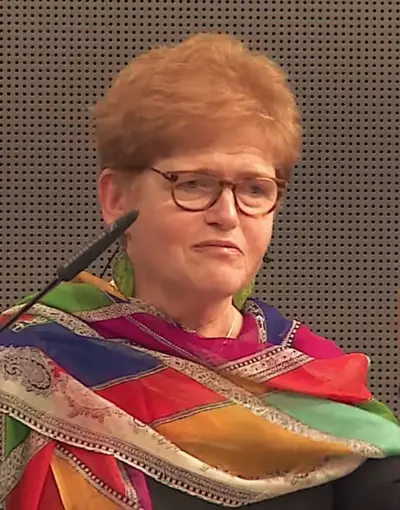
Deborah Esther Lipstadt is an American historian, best known as author of the books Denying the Holocaust (1993), History on Trial: My Day in Court with a Holocaust Denier (2005), The Eichmann Trial (2011), and Antisemitism: Here and Now (2019). Since 1993 she has been the Dorot Professor of Modern Jewish History and Holocaust Studies at Emory University in Atlanta, Georgia, United States.
