Sanjaya Baru Quotes
In some ways, Mr. Modi's foreign policy is a continuation of Dr. Manmohan Singh's, and in some ways, it could be that Mr. Modi was repossessing all the non Nehru-Gandhi leaders of the Congress.


This is another example of how President Roosevelt conducted his own international diplomacy independent of his own State Department. At the time, the U. S. State Department would not have any contact with Nehru who was in and out of British Indian jails for his anti-Colonial agitating. Roosevelt, however was a great admirer of Nehru and the Congress party and the commitment to democracy, freedom of religion, speech and the press and civil rights. Roosevelt and the American military strategic leaders were beginning to worry that China, even with help, would not be able to hold off the Japanese aggression, and India would become a frontier for the Allied war effort. The President realized that Nehru and his Congress Party were pressuring England for independence and extreme Indian nationalists were advocating non-support of the British military effort and strikes and protests to bog down the British army dealing with them instead of fighting the Japanese in Burma and elsewhere. There were a large number of Indian Brigades fighting for the British and if the Indian military volunteers were to be discouraged or boycotted, the allied war effort would suffer. So the President's style was to personally see what he could contribute over and above (and often to the distress of) his agencies established to do the job.

He was referring to the President of Egypt in the midst of the Egyptian soft revolution of 2011. Wisner had been asked by the President to tell the corrupt and dictatorial President of Egypt to step down quickly. A few days later, Wisner gave a speech calling for the 30 year Egyptian dictator to finish out his term so he could “steer the changes”. He claimed that he was not speaking for the administration in this speech but it was a personal view. However, the speech created much world confusion as to what the US administration policy actually was. The quotation illustrates one of the problems of conducting diplomacy in a free democracy. A president asks a citizen to represent him; he does, and then turns around and undercuts the very position he was supposed to take. In many counties such an disloyal act would be considered treason but in America there is nothing the administration could do about it, other than to say that the Munich speech was contrary to US policy.


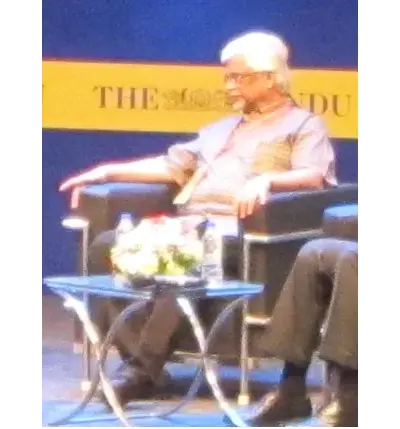
Sanjaya Baru is a political commentator and policy analyst. He served as Secretary General of the Federation of Indian Chambers of Commerce and Industry from May 2004 until August 2008. He has also served as associate editor at The Economic Times and The Times of India, and then chief editor at Business Standard. His father B. P. R. Vithal was Finance and Planning Secretary during Dr. Manmohan Singh's tenure as Secretary of Finance in the Government of India.
