Desmond Tutu Quotes
In its history, Europe has committed so many massacres and horrors that it should bow its own head in shame.
Tutu, Desmond. God Is Not a Christian, and Other Provocations. HarperOne, 2011.

Greece had always coveted Anatolia which was a part of the Ottoman Empire but had been in antiquity a Greek dominated area. Further, people of Greek ethnicity and culture, who hundreds of years ago used to be the vast majority were, after the hundreds of years of Ottoman rule and migration, were then the largest minority in Anatolia. The Turks lost the First World War as a consequence of their allying with Germany, and had been stripped of their vast Arab territories. Also, Turkey had just undergone a revolution and the old order was displaced. Greek Nationalist Prime Minister Venizelos saw this as an opportunity to get back Anatolia and sent a military invasion force to land at Smyrna (Ismir to the Turks), the largest city of Anatolia where despite the Greek minority in all of Anatolia, Greeks were a small majority in Smyrna. The invasion was initially successful but was then repulsed by the Turk revolutionists lead by their great patriot Ataturk who counterattacked and defeated the Greek forces handily despite the fact that they were hastily organized, untrained together, and much more poorly equipped than the Greeks. However, the Greeks in their retreat, followed a scorched earth policy and as this quotation shows, committed many atrocities against the Turkish civilian villages.


This was part of the continual conflict between the Muslims and the Eastern Orthodox Christians. The Greeks ended up doubling their territory.


The Congresswoman was referring to the fact that the U. S. Defense Department had trained Indonesian military officers who had leadership roles in the massacres and other human rights violations in East Timor in 1999.


See Ferdinand I for the Bulgarian denial {601322}.


The Colonel defined people capable of bearing arms as males and females over 20 years of age. Many were slaughtered. Fortunately, most of his officers and men did not follow this order but enough did to make it one of the most disgraceful events in American military history. Smith was court marshaled and found guilty but his punishment was to be cashiered from the army. There were many atrocities committed by the minorities of both sides in this brutal war. Military and Congressional Investigations caused the army manual to be revised military policies reformed.

Saloth Sar Pol Pot. He was responsible for the brutal killing of over 1 million of his own people.


He arrived in 1527, 7 years before De Soto and in a 6,000 mile ordeal, was the first white to cross the explore the interior of the continent. He was describing the Spanish slavers behavior with respect to the Indians of the New World.

Jinnah and other Muslim leaders had stirred up the Muslims to violence to put pressure on all the parties to accede to Jinnah's Muslim League's demand of an independent Muslim nation—Pakistan. Messervy was very sympathetic to the Muslim leadership as he had been feuding with and frustrated by the predominantly Hindu ruling Congress Party. After partition he accepted the mercenary position of Commander in Chief of the Pakistani Army. Then he was shocked and horrified at the slaughter of the terrorist attacks by the Muslims—about 4,000 Sikh men, women and children had been beaten and cut to death. The Sikhs had been targeted largely because Sikh leaders had recently announced that if there were a Partition, Sikhs would refuse to live in nation under Muslim control.
First Published American Indian Author. His last public speech. He was referring to a horrible massacre of Christian Indians and the polarizing effect that such conflicts had. Whosoever publicly castigated a massacre of whites or Indians would be met by accusations of condoning the massacres of the other side and ignoring the inevitable and natural seeking of retaliation for future protection and revenge.


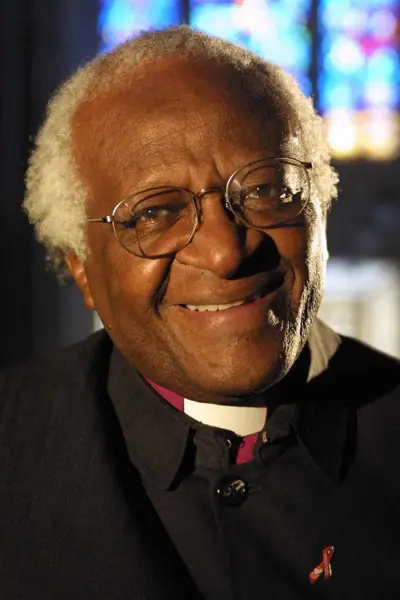
Desmond Mpilo Tutu OMSG CH GCStJ is a South African Anglican cleric and theologian, known for his work as an anti-apartheid and human rights activist. He was the Bishop of Johannesburg from 1985 to 1986 and then the Archbishop of Cape Town from 1986 to 1996, in both cases being the first black African to hold the position. Theologically, he sought to fuse ideas from black theology with African theology.
