Mary Robinson Quotes
In human rights theory it is very important that governments still have the primary responsibility for the standards and provision of such services even if they no longer deliver them. They must insist that the private sector delivers without discrimination. So governments still have responsibility, including the need to influence business.
Robinson, Mary. A Voice for Human Rights. Edited by Kevin Boyle, University of Pennsylvania Press, 2006.


He was referring to water rights where short term agreements might have disastrous consequences for future generations. Under the WWI Peace Treaty the high court of Egypt was an International Court. President Wilson nominated Crabites to this court and he served there for 3 decades during which he became a world class expert in Middle Eastern affairs. The failure to have a long-term perspective was a Middle Eastern problem then and did not improve in the next century.


Cochrane became the Admiral in Chief of 2 Different South American Nations—Peru and Brazil—fighting for their independence. Incredibly enough, he was able to form idealistic freedom fighters with no naval experience into navies which defeated both the Spanish and Portuguese fleets at a time when those countries had world class navies. His achievements on behalf of the South Americans are often regarded as the most remarkable naval achievements in history.


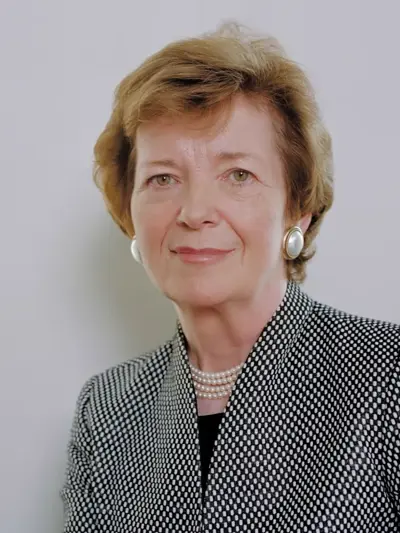
Mary Therese Winifred Robinson is an Irish independent politician who served as the seventh President of Ireland from December 1990 to September 1997, becoming the first woman to hold this office. She also served as United Nations High Commissioner for Human Rights from 1997 to 2002 and a Senator for the University of Dublin from 1969 to 1989. She first rose to prominence as an academic, barrister and campaigner. She defeated the Fianna Fáil party's Brian Lenihan and the Fine Gael party's Austin Currie in the 1990 presidential election, becoming the first Independent candidate nominated by the Labour Party, the Workers' Party and Independent Senators. She was the first elected President in the office's history not to have had the support of Fianna Fáil.
