Zygmunt Bauman Quotes
In a world of global dependencies with no corresponding global polity and few tools of global justice, the rich of the world are free to pursue their own interests while paying no attention to the rest.
Bauman, Zygmunt. Globalization: The Human Consequences. Polity Press, 1998.


The crisis of inequality of income and wealth has occurred seven times in American history.


This important statement would not have been a noteworthy quote as so many have said it before, except for the fact that she was writing as a spokesperson of Nationalist China and she was the wife of the Nationalist Party leader, Chiang Kai-Shek. And the great failure of Chiang’s governance was the corruption and the excessive exploitation of the Chinese people by the wealthy. Madame Chaing, educated at Vassar College, knew just what to say to Americans and she mustered incredible support for the Nationalist cause most of which would never have been forthcoming if Americans knew the truth about the Nationalist Government. It was so corrupt, that the vast majority of the people aided the Communists in defeating Chaing, expelling him from the mainland, and relegating his government to Taiwan. Madame Chaing’s hypocrisy was legend. See {615696}.

The same greatest issue was still before the people a century later. See {633217} , {635104} & {630538}.
This was written in 1933 one of the worst years of the Great Depression. Actualy many upper middle calss and rich people were ruined themselves by the Great Depression, but at the same time the ultra rich were living in a "gildd age" and reveled ostentatiously.


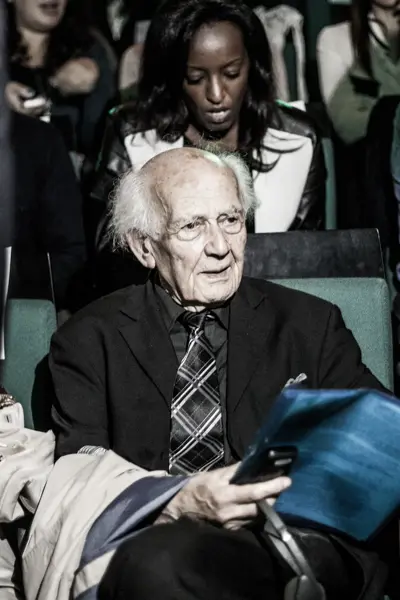
Zygmunt Bauman was a Polish sociologist and philosopher. He was driven out of the Polish People's Republic during the 1968 Polish political crisis and forced to give up his Polish citizenship. He emigrated to Israel; three years later he moved to the United Kingdom. He resided in England from 1971, where he studied at the London School of Economics and became Professor of Sociology at the University of Leeds, later Emeritus. Bauman was a social theorist, writing on issues as diverse as modernity and the Holocaust, postmodern consumerism and liquid modernity.
