James Buchanan Quotes
If you are as happy, my dear sir, on entering the house as I am in leaving it and returning home, you are the happiest man in this country.
Buchanan had a very difficult time in his Presidency. There was enormous pressure from the abolitionists to curtail slavery and there was equally passionate pressure from the slave owners to not only maintain slavery as an institution but expand it into the Western territories. Buchanan tried to continue what had been successful since 1787—appeasing the South and persuading the North to go along to maintain national unity. Except the nation was polarizing on the slavery issue and there was no way to “compromise” slavery any longer. Buchanan ended up alienating both sides. He left office and handed the “hot potato” to Lincoln.
James Buchanan, 1791-1868, 15th President of the United States (Democrat, PA), Statement to Abraham Lincoln who was taking his place in the White House, March 4, 1861
Sourced by: Eigen's Political and Historical Quotations


After Adams took the oath of office, he wrote to his wife Abigail about Washington's great satisfaction at leaving office:


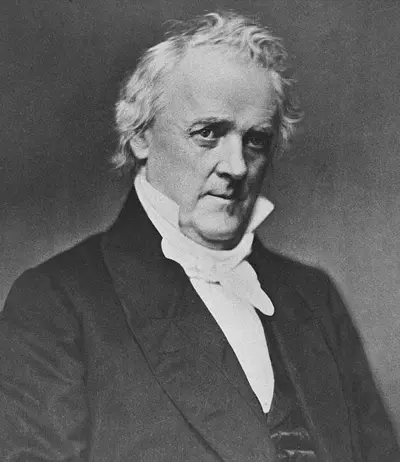
James Buchanan, Jr. was the 15th President of the United States (1857–61), serving immediately prior to the American Civil War. He represented Pennsylvania in the United States House of Representatives and later the Senate, then served as Minister to Russia under President Andrew Jackson. He was named Secretary of State under President James K. Polk, and as of 2016[update] is the last former Secretary of State to serve as President of the United States. After Buchanan turned down an offer to sit on the Supreme Court, President Franklin Pierce appointed him Ambassador to the United Kingdom, in which capacity he helped draft the Ostend Manifesto.; James McGill Buchanan, Jr. was an American economist known for his work on public choice theory (included in his most famous work The Calculus of Consent), for which he received the Nobel Memorial Prize in 1986. Buchanan's work initiated research on how politicians' and bureaucrats' self-interest, utility maximization and other non-wealth maximizing considerations affect their decision making. He was a member of the Board of Advisors of The Independent Institute, a member (and for a time the President) of the Mont Pelerin Society, a Distinguished Senior Fellow of the Cato Institute, and professor at George Mason University.
