Johnetta B. Cole Quotes
If there’s a church that says there is a right to life and then goes and kills people in abortion clinics and executes Black people in prison, then I don’t need that church.
Johnetta B. Cole, President, Spellman College, Speech, Vassar College, State of Black America Forum, Washington DC, February 3, 2001
Sourced by: Eigen's Political and Historical Quotations

Justifying his support of the Hyde Amendment prohibiting Federal funds to be used to perform abortions. Carter was normally a staunch defender of equal opportunity for the poor, but the Hyde Amendment de facto prohibited poor women from exercising their rights to have abortions while middle class and wealthy women could exercise that right.. The hypocrisy was difficult for him to explain.


This is an example of a twisted kind of political logic that says that if there are law breakers who don't like legal behavior of others and will therefore commit violent crimes if they continue to act legally, the law should be changed to make the behavior illegal so they criminals and murderers will not be so angry. However, there are few people who actually believe this. An ironic thing about this man is that his rabid opposition to abortion is based on his interpretation of the Bible (Old Testament) which never mentions abortion as a crime. (The Early Hebrews and Christians practiced abortion and saw no Biblical stricture against it.) However, he claims that the Biblical crime of bestiality—punishable by death—should be normalized. See {583375} for an example of this hypocrisy.


He was the son of LeRoy Percy a Governor of Mississippi, who was running for that post against James Kimble Vardaman, an unabashed Racist, populist, and hate-monger. (See the related quotes for examples.) He appealed to the worst of the Mississippi. This was his famous description of the crowd that turned out for a Vardaman rally in 1903,

Instead of standing and saluting as professional athletes have done for decades before games, he kneeled and refused to stand. This caused great public criticism but also some initial support. He was potentially risking his multimillion dollar salary as this technically violated his contract to avoid anything embarrassing to the team. He also donated $1 million to programs in the area that were working to enhance Black/white understanding. Even those who disagreed with his choice of protest defended his right to do so, and after the initial furor, public opinion, while not in agreement about his method, tended to support him for having the courage of his convictions and using his celebrity for a worthy cause. After sensing the public opinion, his team matches his $1 donation. Professional athletes both in the NFL and in other sports then began to do the same as a form of protest for the large, disproportionate, number of black men who were killed, mostly when unarmed, by police. The reference to the “paid leave” was the practice followed by most police departments—usually required by collective bargaining agreements with police unions—of placing police officers accused of committing violations of laws or regulations on paid administrative leave while all the investigations, hearings, and other processes . While this practice protected the rights of those police officers who were not guilty, it ended up paying brutal murders for a some time entire their case was decided or acted upon be the district attorney.


Billy Sunday was the most famous preacher of the day. Unlike the vast majority of white preachers, he not only preached to black audiences but exuded an atmosphere of friendliness and comfort around Blacks that amazed most. Most Black leaders thought Sunday was very good for race relations, but there were some clergy like Grimke who criticized him. Sunday was castigated by many racist whites for preaching to Blacks, but he did not go as far as to condemn or preach against racism and the discrimination of the day and he would not preach to an integrated audience. Grimke, in contrast, preached to an integrated congregation and was one of the few white clergy who did in the South. (Washington DC was then a southern, segregated city.) See {585415} for another critique of Sunday.
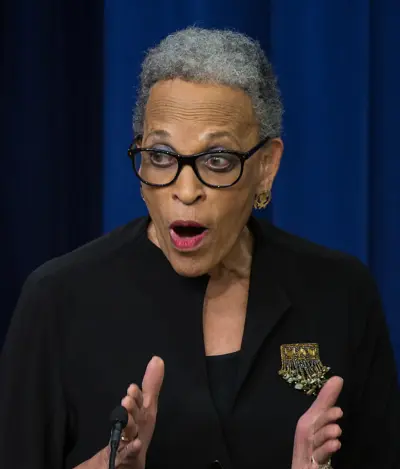
Johnnetta Betsch Cole (born 1936) is an American anthropologist, educator, museum director, and college president. Cole was the first female African-American president of Spelman College, a historically black college, serving from 1987 to 1997. She was president of Bennett College from 2002 to 2007. During 2009–2017 she was Director of the Smithsonian Institution's National Museum of African Art.
