John Tyler Quotes
If the tide of defamation and abuse shall turn, and my administration come to be praised, future Vice-Presidents who may succeed to the Presidency may feel some slight encouragement to pursue an independent course.
Tyler, John. Quoted in John Tyler: Champion of the Old South, by Oliver Perry Chitwood, D. Appleton-Century Company, 1939, p. 320.


Vice Presidents serve as President of the Senate, and their marble busts are displayed in the Senate part of the Capitol Building.

The Senate was debating a law to make torture of foreigners and captives illegal under all circumstances. Vice President Cheney was very strongly opposed wanting an exception made for the CIA.


Attacking FDR by pandering to anti-Semites and falsely claiming that a Jewish financier, Bernard Baruch ran the government: The Priest was the right wing demagogic radio host of his day. Virulently anti-Semitic and anti-Black, he was threatened with excommunication by the Catholic Church, which finally ordered him to cease us weekly radio show and stop the political hate.


President Donald Trump was extremely egocentric


There were however several instances of torture being used. The administration used the term “enhanced interrogation” for waterboarding and other acts that the US has previously punished Americans for using. The George W. Bush administration actually had a team of their lawyers in the Justice Department write a memo to uniquely define torture so as not to include the torture techniques that were used as “enhanced interrogation”.

This quotation illustrates an interesting phenomenon in American Presidential Politics. There have been Democratic Presidents (FDR and Obama are the most glaring examples) for whom there was vituperative hatred and derision from the conservative Republicans who would frequently refer to them as Socialists and would believe that they were trying to lead the country on the path to socialism. The Presidents always stated that they were opposed to socialism, but to little avail with their conservative haters. But the socialists of the times and even the left wing of the Democratic Party not only did not see them as socialists, but were not very supportive or complementary of their skills and capabilities. Roosevelt reveled in the situation and “welcomed: their hate. Obama was more of a public centrist who tried to avoid the president getting involved in the extreme partisanship of the day.

The President tends to keep increasing the number of Americans who are opposed to his policies, or felt he did not live up to his promises, or has been sufficiently negatively trashed by his opposition that his negatives are driven up and positives, down. The only exception to this is President William Clinton, who ironically is the only President who was impeached since Andrew Johnson, a terrible President. However, the pettiness and partisanship of the impeachment attack on Clinton caused the Senate to acquit him where the Republicans who controlled the Senate could not even muster a majority, much less the two-thirds necessary, for conviction. Meanwhile, with all the distractions of impeachment, Clinton managed the strongest economy in American history, not only balanced the budget, but created a surplus for the first time in modern history. So Clinton left office, a hero and his popularity was sustained after his presidency as George W. Bush, following a new Republican ideology, squandered the surplus, created very few jobs, and then crashed the world economy triggering the Great Recession of 2008. He left the Presidency as one of the more unpopular Presidents in history. By contrast, Clinton’s accomplishments were even more appreciated as Bush was his foil.


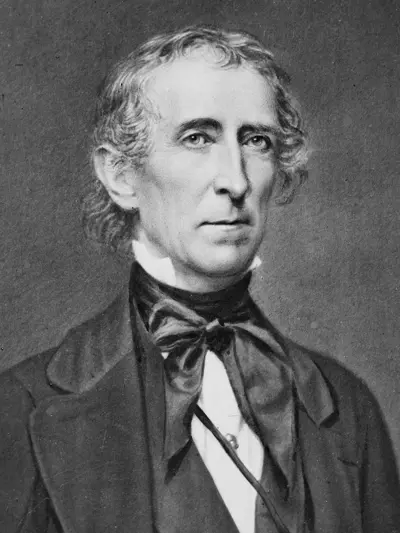
John Tyler was the tenth president of the United States, holding office from 1841 to 1845 after briefly serving as the tenth vice president in 1841; he was elected vice president on the 1840 Whig ticket with President William Henry Harrison. Tyler ascended to the presidency after Harrison's death in April 1841, only a month after the start of the new administration. He was a stalwart supporter and advocate of states' rights, and he adopted nationalistic policies as president only when they did not infringe on the powers of the states. His unexpected rise to the presidency posed a threat to the presidential ambitions of Henry Clay and other politicians, and left Tyler estranged from both major political parties.
