Charles Kettering Quotes
If I want to stop a research program I can always do it by getting a few experts to sit in on the subject, because they know right away that it was a fool thing to try in the first place.
Boyd, T. A. Professional Amateur: The Biography of Charles Franklin Kettering. E. P. Dutton & Co., 1957.


The “experts” were scientists and science educators who had testified that Creationism, a notion that some religious Christians believe is a more valid explanation of the development of plants and animals than is Evolution, is a religious belief, not a science and should not be taught in a science curriculum. McLeroy believed that even in teaching science, scientific thinking and expertise should not be given more weight than religion in general and Christianity in particular. Some fundamentalist Protestants find Evolution distressing in that it contradicts the literal Biblical narrative. Other Protestants, Jews, and Catholics do not see anything in Evolution that conflicts with their spiritual view of God. They see Evolution as the mechanism that God created for the development of life. McLeroy was defeated in the next election after taking this anti scientific position, and was replaced with another fundamentalist Protestant—but one who did not believe that a particular Protestent, Christian view of the world which scientists generally reject should be taught as science in public schools.

3rd Earl Russell of Kingston


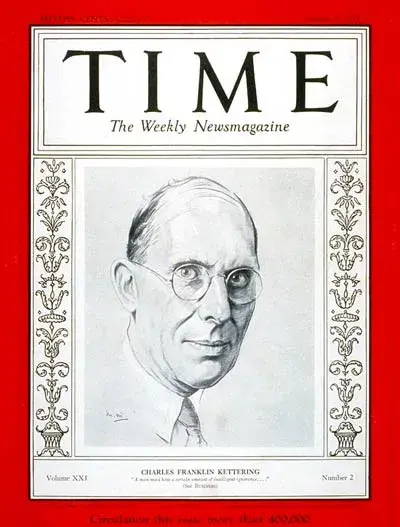
Charles Franklin Kettering sometimes known as Charles "Boss" Kettering was an American inventor, engineer, businessman, and the holder of 186 patents. He was a founder of Delco, and was head of research at General Motors from 1920 to 1947. Among his most widely used automotive developments were the electrical starting motor and leaded gasoline. In association with the DuPont Chemical Company, he was also responsible for the invention of Freon refrigerant for refrigeration and air conditioning systems. At DuPont he also was responsible for the development of Duco lacquers and enamels, the first practical colored paints for mass-produced automobiles. While working with the Dayton-Wright Company he developed the "Bug" aerial torpedo, considered the world's first aerial missile. He led the advancement of practical, lightweight two-stroke diesel engines, revolutionizing the locomotive and heavy equipment industries. In 1927, he founded the Kettering Foundation, a non-partisan research foundation. He was featured on the cover of Time magazine on January 9, 1933.
