J. Edgar Hoover Quotes
I would doubt that those people down there would even give them that much of a break.
Three civil rights workers were kidnapped in Mississippi by members of the Ku Klu Klan in 1964 (Goodman, Schwerner and Chaney) and after a few days the FBI found the car in which they had been driving. He reported to the President that they had been probably been killed. The President asked Hoover why they could not have been kidnapped and taken to somewhere else and held there. This was his answer. He turned out to be right. They were brutally murdered. An all white jury acquitted the murderers, but in 2005 the leader was again tried for murder. The Southern-dominated Senate for years would not pass any anti-lynching legislation and thousands of blacks and some sympathetic whites were brutally tortured and killed. In 2005, the Senate passed a resolution 98-0 apologizing for the inaction over the years on lynching. The two missing senators who did not vote for the resolution were from Mississippi.
J. Edgar Hoover, 1895-1972, Director, Federal Bureau of Investigation, Phone Conversation with President Lyndon Baines Johnson, 1964
Sourced by: Eigen's Political and Historical Quotations


The president had not only sunk I the polls, but for the first time only a minority then thought that he was trustworthy. The Congress was even lower in public esteem. The approval for the Congressional Republicans was down to only 9 percent—the lowest since the poll had been taken.


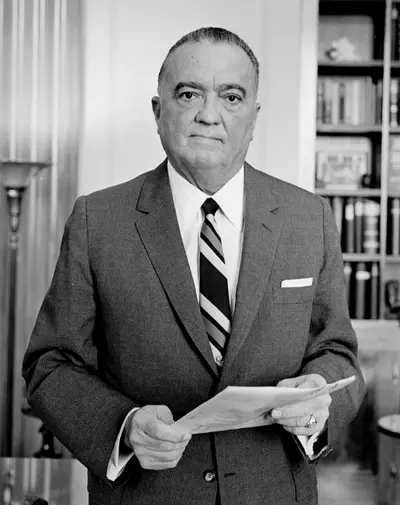
John Edgar Hoover was an American law enforcement administrator who served as the first Director of the Federal Bureau of Investigation (FBI) of the United States. He was appointed director of the Bureau of Investigation – the FBI's predecessor – in 1924 and was instrumental in founding the FBI in 1935, where he remained director for another 37 years until his death in 1972 at the age of 77. Hoover has been credited with building the FBI into a larger crime-fighting agency than it was at its inception and with instituting a number of modernizations to police technology, such as a centralized fingerprint file and forensic laboratories. Hoover is also credited with establishing and expanding a national blacklist, referred to as the FBI Index or Index List, renamed in 2001 as the Terrorist Screening Database which the FBI still compiles and manages.
