Dwight D. Eisenhower Quotes
I want to give businessmen an honorable place but they make crooks out of themselves.
Dwight D. Eisenhower, 1890-1969, 34th President of the United States (Republican, KS), Supreme Allied Commander in Europe, Quoted in Donavan, Confidential Secretary
Sourced by: Eigen's Political and Historical Quotations


See {586119} for an earlier English version of this point.


In 1961 the President intervened in a labor dispute in the steel industry with the "understanding" that the steel companies would not raise their prices after the settlement. As soon as there was a settlement prices were raised:. The President "persuaded" the steel executives to rescind the increases.


The two politicians were amazed as they learned more and more about some of industrial leaders of the country. This is the language they used in private communications.


This quotation, in addition to posing a challenging political question, illustrates an oratorical technique that he was particularly good at. Instead of making declaratory and accusatory statements about the administration and their law enforcement record, he asks the question of how the actual outcome came about. The failure is then clear, and the accusation is made in the minds of many if not most of this audience.

This is a very important quotation. No one likes to make moral compromises, but Mann realized that there was a necessity in a complex society—especially a republic to make compromises. Politics cannot function without compromises of all kinds moral and otherwise as different people have different views of morality and rectitude. Mann observed that if compromises must be made, it is better for the politicians to make them than the educators, physicians, clerics, and other professional groups. Therefore politics takes the heat so that the other institutions of society do not have to. Thus politics has this crucial role among its others according to Mann.
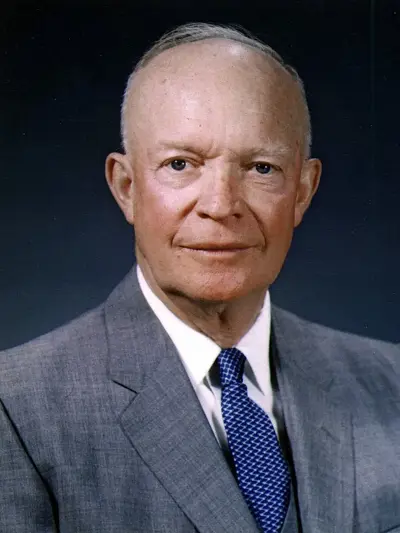
Dwight David "Ike" Eisenhower GCB OM GCS CCLH KC NPk was an American military officer and statesman who served as the 34th president of the United States from 1953 to 1961. During World War II, he became a five-star general in the Army and served as Supreme Commander of the Allied Expeditionary Force in Europe. He was responsible for planning and supervising the invasion of North Africa in Operation Torch in 1942–43 and the successful invasion of Normandy in 1944–45 from the Western Front.
