Sam Ervin Quotes
I used to think the Civil War was our country's greatest tragedy, but I do remember that there were a few redeeming features in the Civil War in that there was some spirit of sacrifice and heroism displayed on both sides. I see no redeeming features in Watergate.
Samuel J. Ervin Jr., 1896-1985, U. S. Congressman & U. S. Senator (Democrat, NC), Statement, Senate Watergate Hearings, 1973
Sourced by: Eigen's Political and Historical Quotations

This would be like an American President firing the congressional chaplains. However this is only one small, but telling, example of Atatuk’s secularization of the nation which had a great deal to do with Turkey becoming a modern great power—by far the strongest and most developed of the Islamic world.


_0_PostageStamp_47x47.jpg "Chairman of the Joint Chiefs of Staff Navy Adm. Mike Mullen gives an interview to John Dickerson during the CBS news program Face the Nation in Washington, D.C., July 5, 2009. During the interview, Mullen discussed the wars in Iraq and Afghanistan, North Korea's recent missile tests and his recent visit to Russia. (DoD photo by Mass Communication Specialist 1st Class Chad J. McNeeley, U.S. Navy/Released)")

Trumbo was morally opposed to war. He also refused to name Hollywood communists to Congressional Committees during the Red Scare. He was then blacklisted from his occupation, screen writing.


Reports were widespread that General Grant was an alcoholic and was frequently drunk in the field. Lincoln was under pressure to relieve Grant of his command in the West. To a Pennsylvania politician he explained:


Drumbo was morally opposed to war. He also refused to name Hollywood communists to Congressional Committees during the Red Scare. He was then blacklisted from his occupation, screen writing.


He drove the British into the sea when no one expected that outcome.

This line was used in the WPA Federal Theater Project. The play was closed down, because the State Department was distressed that the Federal Theater quoting heads of State might be insulting to the world leaders. Mussolini was another character in the play and he was depicted as the boorish thug that he turned out to be. It was that which offended the government officials who closed the show before it could open. FDR used a similar line 6 years later. See {32529} . Dolores Ibarruri in the Spanish Civil War is quoted with a similar phrase at about the same time. See {604321}

Dole, was seriously wounded in WWII and lost the use of one arm.

Lincoln was opposing the Mexican War.

Sung to the tune of an old English pub song, "Down at the Olde Bull and Bush." The Congressman also fancies himself a pianist.

That is the way he was killed. The phrase, “We are bound to believe that, anyhow” indicates that Stuart really realized how futile the Southern war effort would be but loyalty and patriotism required him to suspend his rational belief structure.
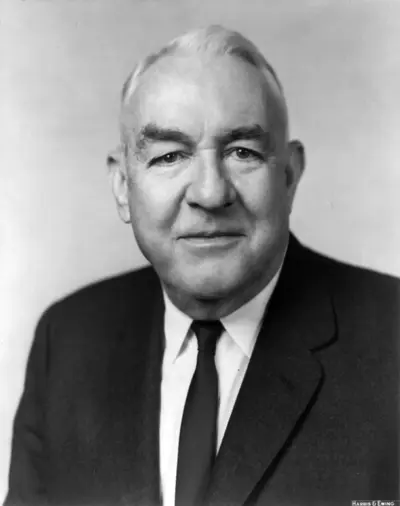
Samuel James Ervin Jr. was an American politician. A Democrat, he served as a U.S. Senator from North Carolina from 1954 to 1974. A native of Morganton, he liked to call himself a "country lawyer", and often told humorous stories in his Southern drawl. During his Senate career, Ervin was a staunch defender of the Jim Crow laws and racial segregation, as the South's constitutional expert during the congressional debates on civil rights. Paradoxically, he was also known for his support of civil liberties. He is remembered for his work in the investigation committees that brought down Senator Joseph McCarthy in 1954 and especially for his investigation of the Watergate scandal in 1972 that led to the resignation of Richard Nixon.
