Sir Frederick Browning Quotes
I think we might be going a bridge too far.
Sir Frederick “Boy” Browning
Sir Frederick Browning, 1896-1965, English soldier, Remark to Field Marshal Montgomery, September 10, 1944, Quoted in Urquhart, Arnhem, 1958
Sourced by: Eigen's Political and Historical Quotations


The English were at War with Napoleon and Denmark was neutral. British leaders feared that Denmark might either ally themselves with Napoleon or provide him with ships from their well equipped fleet. The English decided on a preemptive attack on Denmark and military forces were ordered to Denmark. When they arrived, they were ordered to bombard Copenhagen and force the Danes to surrender. When this happened, the British seized the Danish ships and simply took them as war prizes. The issues of the morality and wisdom of preemptive attacks, as with the Americans in the Iraq war, was thoroughly debated but the government view prevailed to the shame of most Englishmen.


The allies had differences in desirable strategy alternatives. Russia was facing the German Army on its Eastern front and causing huge German casualties but were paying for them in large loss of Russian life—civilian and military (The Russians suffered 22 million deaths as a result of WWII.) Stalin wanted to open a second front in France which would force the Germans to move some divisions from the Russian front, thereby relieving some of the pressure.
War between England and Germany had just commenced.
War between England and Germany had just commenced. The last sentence refers to the fact that Hitler had recently signed a peace pact with Stalin to everyone’s surprise as Hitler told the German people over and over that Russia was Germany’s biggest enemy. The pact was only a ruse on Hitler’s part to delay Russia’s entry into the war. Hitler broke the treaty and invaded Russia a little later.

The Prime Minister, Neville Chamberlain, preceded him with the announcement of declaration of war against Germany, but it was left up to the Foreign Minister to explain the implications. This was the first time in history that a nation had used radio to communicate such momentous events to its population.

The British and American bombing of Germany had become so effective that most of the German industrial system was destroyed. However, early in the War, Germany had violated the Geneva Convention and was indiscriminately bombing London and other part of England. In addition the German Air Force had bombed Warsaw, and many other cities throughout Europe. The German’s had killed over 20 million Europeans. When the Allied bombing produced high collateral damage against civilians, some argued that even though German had deliberately used this tactic, the allies should stop the saturated bombing if there were to be high civilian collateral damage. Others argued that it was unfortunate but a military necessity. There were others like Brenen, who argued that killing German women and children was desirable and just.

This has been true in just about every conflict. In WWII however, there were a highly disproportionate ration of atrocities with those of the axis forces dwarfing those of the U. S. and its allies. Further, after the war, those allied atrocities that did take place were published. In addition, one basic difference is in the policies of the fighting forces and their governments as opposed to individual actions by soldiers. In WWII, the allied atrocities were of the latter type, but the axis atrocities involved both.

This was another of Palin’s gaffs reflecting on her shallow knowledge of American History. Paul Revere’s ride was for the purpose of warning Samuel Adams and John Hancock and the Americans along the way. It was not to warn the British of course. However, there was a grain of truth in her misstatement. Halfway on his ride, Revere was stopped by the British and questioned. The British were on their way to capture the Armory and its weapons. Revere did tell the British that as a result of his warning the Americans along the way, there would likely be 500 patriots in defense. So in a sense, Revere “warned” the British. This is another of example Palin’s shallow understanding of events and ideas for which she was notorious. See {623710} for a historians view. She was following the Freedom Trail in Massachusetts and commenting for the press at every opportunity. Ironically, Palin. In her own inimitable style, was loquacious on a subject she had not studied or prepared for.


The Russians had lost over 20 million of its people to German WWII hostilities. They wanted a vengeance and were willing to take the casualties that came with the invasion of Berlin and many other key cities that were heavily defended. Eisenhower and Churchill realized that this would give the Russians a very dominant military occupation of Eastern Europe and Eastern Germany. However, they did not want to take the huge casualties of all these battles. Politically, Churchill and American leaders had to explain to their right wings why Russia was involved as an equal partner in making occupation decisions about Germany.


This admonition of his applied not only to initiating war, but to increasing unemployment for a worthy purpose like controlling inflation. He sought solutions where pain was borne by tall if necessary, but not to particular subgroups (identifiable or not) to the degree that they would suffer badly. In general, we should not sacrifice some for the good of the whole without their volunteering, as in a volunteer army.

This historic speech is regarded as one of the most important in Australia's history, marking a turning point in Australia's relationship with its founding country, the United Kingdom. Many felt that Prime Minister Curtin was abandoning Australia's traditional ties to the British Isles. -- Wikipedia
Some scholars look back at the allied bombing of German Cities in WWII with criticism that it was morally improper to bomb populated cities, and that the use of the adjective “exterminating” indicated that Churchill was more interested in killing Germans than strategic victory. This revisionist history has two failings. First, the Germans had already bombed Coventry, London and other civilian targets in England as well as cities in Holland, Poland and other countries killing many civilians. As a result, under the rules of war, Germany was no longer entitled to protection for their cities. Further, Hamburg and other targets were manufacturing sites of war material and as such lost the protection anyway. Even Dresden, which had very little war manufacturing was the main location for R&R of German Officers and by their military presence in the city converted it into a legitimate target. FDR agreed with Churchill, that the bombing was a good strategy to cause Hitler to fall as they thought the public would rebel. They were wrong however and his grip on the population through the Gestapo and the military was so strong that, it took a land invasion and occupation to put an end to Hitler. However, the devastating bombing all but crippled the German weapons development and deployment. For example. The Germans had developed the Jet Airplane Engine and actually put a few in the fight at the end if the war. Without the bombing, they would have had many more and countered the allied air supremacy. However, it is also true that Churchill and many Englishmen and some Americans believed that the English were morally entitled to retaliation for the innocent civilians killed with the German bombing of civilian targets.

The automobile assembly lines of Detroit, had been planned to be converted to factories to produce a huge supply of planes, tanks, trucks and guns which were instrumental in winning the Second World War.

The Admiral had spent time in the United States. He strongly opposed Japanese warring against America. When his recommendations, were rejected and war was decided upon, Yamamoto planned and commanded the Attack on Pearl Harbor.

At this point, the horrors of the German concentration death camps were generally known by the world press. This quotation shows the denial that the Irish Free State was in about the German Nazi atrocities. The 6-county Nationalsits were the Irish counties in Northern Ireland that did not join the Irish Free State and so far as the Catholic Irish were concerned, the Catholics of Northern Ireland were a persecuted minority undergoing oppression and that was not they believed morally different from the murders of millions of Jews, Gypsies and handicapped people in Europe. If the Free State Irish publicly admitted the difference, they would morally have had to join the allies and De Valera was totally opposed to that. Over 70,000 Irishmen and women rejected the moral stand of their government, and volunteered for the British Army to the great distress of the Free State leaders like De Valera. See {639722} for his personal denial of reality.
At first reading, this is just a common report of a German war correspondent riding along on a bombing mission. However what makes it a very important historical quotation is the description of the fires and the date. In WWII the allies firebombed Hamburg {624722} and Dresden, and were then accused by the Germans—and by some historical revisionists in the 21st century—of bombing civilian cities and using the firbombing technique where one huge conflagrant sucked the air out of the area and roasted even people in bomb shelters. However, it was clear that the Germans had started the bombing of civilian cities, but the firebombing was less clear. This quotation proves that it was the Germans who first broke the rules of war and that made the subsequent Allied use of the technique legal and for most people then moral.
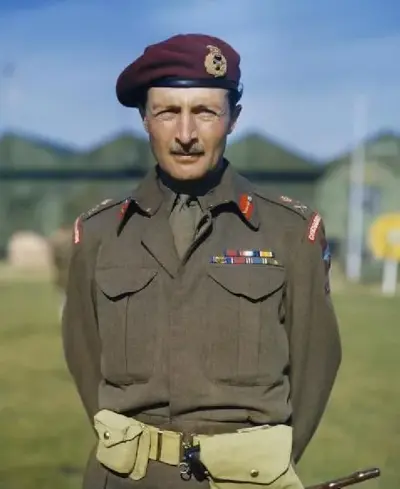
Lieutenant-General Sir Frederick Arthur Montague "Boy" Browning, GCVO, KBE, CB, DSO was a senior officer of the British Army who has been called the "father of the British airborne forces". He was the commander of I Airborne Corps and deputy commander of First Allied Airborne Army during Operation Market Garden in September 1944. During the planning for this operation, he memorably said: "I think we might be going a bridge too far." He was also an Olympic bobsleigh competitor, and the husband of author Dame Daphne du Maurier.
