Milton Friedman Quotes
. . I think the Adam Smith role was played in this cycle i.e. the late twentieth century collapse of socialism in which the idea of free-markets succeeded first, and then special events catalyzed a complete change of socio-political policy in countries around the world by Friedrich Hayek's The Road to Serfdom.
Friedman, Milton. Interview.


China was going though a major change of economic structure and national policy, moving to a Western style, capitalist, market economy. This was led by Zhao and Deng. However there were ensconced communist, Marxist idealogues still in place in the government, and a few of them were very vocal about their negative reaction to this abandonment of socialist principles. One economists who was particularly vocal was thus warned and reprimanded by Zhao. He got the message.


The mantra was not heard much after the collapse of the ‘smart’ markets in 2008 and the ‘dumb’ governments had to come to the rescue of the economy all over the industrialized world.


Ever since the end of WWII, many Republicans have called their Democratic Opponents Marxists and Communists even for a conservative Democrat like Kennedy. Even Ronald Reagan stooped to this tactic before he ran for the Presidency.

This rigid view left no room for regulation which is what almost every modern industrial democracy has chosen. To some of his extremist followers, any government regulation of business or the economy whatsoever, regardless of how little, means that the nation has embraced socialism. It is in this sense that many extreme right wingers viewed Presidents like Franklin Delano Roosevelt, Harry Truman, John Kennedy, Bill Clinton, and Barack Obama as socialists while they saw themselves as opponents of socialism.

This quotation is surprising for most economic conservatives who assume incorrectly that the major "fathers" of free market capitalism would be opposed to radical welfare notions like providing a h=guaranteed income to all. Perhaps the two most improtant of them actually supported such as scheme on the graunds that it would further free market capitlism, not inhibit it.


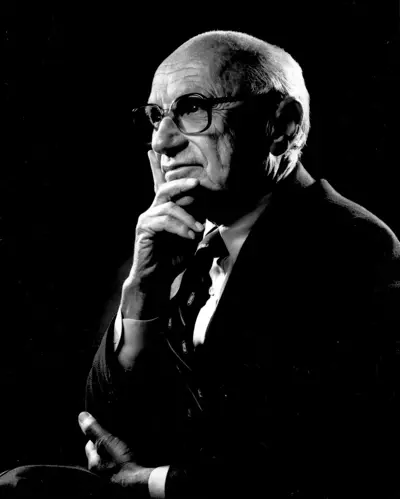
Milton Friedman was an American economist and statistician who received the 1976 Nobel Memorial Prize in Economic Sciences for his research on consumption analysis, monetary history and theory and the complexity of stabilization policy. With George Stigler and others, Friedman was among the intellectual leaders of the Chicago school of economics, a neoclassical school of economic thought associated with the work of the faculty at the University of Chicago that rejected Keynesianism in favor of monetarism until the mid-1970s, when it turned to new classical macroeconomics heavily based on the concept of rational expectations. Several students and young professors who were recruited or mentored by Friedman at Chicago went on to become leading economists, including Gary Becker, Robert Fogel, Thomas Sowell and Robert Lucas Jr.
