Ron Paul Quotes
I think a submarine is a very worthwhile weapon. I believe we can defend ourselves with submarines and all our troops back at home. This whole idea that we have to be in 130 countries and 900 bases... is an old-fashioned idea.
Paul, Ron. "Fox News Republican Presidential Debate." Fox News, 5 May 2011.


No military alliances has been a tradition in American politics which broke down and changed in our allied effort in WWI. Harding and the Republicans of his day, wanted to reestablish that principle of American Foreign policy. They succeeded, but WWII and its Cold War aftermath made a major change in U. S. policy on this point, and NATO was not only a major permanent military alliance, but lasted well beyond the fall of the Soviet Union. America and our NATO allies were so pleased with the benefits of a permanent military alliance, that they preserved it by looking hard for missions that it could take on rather than dissolve NATO.

One difficulty of diplomacy with many Islamic leaders is that the culture produces very aggressive rhetoric and very aggressive actions like Islamic terrorism. This quotation is often cited to demonstrate that it is the Iranians that had decided that America is it’s enemy; that America is to be humbled; and that their weapons development are targeted at America. This along with the most frequent Iranian slogan, “Death to America,” for many argues for preemptive military action or maintenance of a high state of readiness. Given statements like this from the leading soldier of the theocracy, there is little doubt that Iranian nuclear weapons would be a great danger to America. Therefore when Iran complains that America did not object to the fact that other nations have the nuclear bomb, they do not take their own rhetoric into account. No other nation with possible nuclear capability has made America its major military adversity and claims as an objective to humble the United States.


Dreadnoughts were huge battleships. Britain had the dominant navy of the world and controlled the seas. A European war would be a land war where a navy would be of little use. Hence, Britain would not want to get involved in such a war where she could not use her greatest military strength. He was wrong about this and so much else. Britain entered WWI when Germany invaded Belgium fulfilling her treaty obligations. The Germans intelligence operators and analysts were well aware of the treaty obligations, but had little understanding of English culture and tradition. The German aggression against a small power like Belgium was morally offensive to many in Great Britain, and Britain had a tradition of fighting for moral principles. The Germans would never militarily disadvantage themselves for the sake of a treaty obligation to a small nation, and they did not believe that the British would be so different and fulfill their treaty obligations even though their strongest military asset—their navy would not be very helpful.

Russia is not the only nation who believed this. There were and are some politicians and military officers in almost every country who believe this. However, for the last few centuries, this has rarely been the view held by the majority of the politicians and military in most nations. And even fewer where the leadership accepted this posiitin. Russia, was one of those counties that did hold this few and kade it policy was in the 2nd decade of 2016,


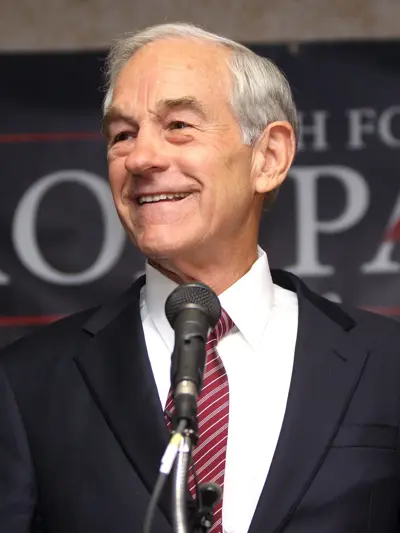
Ronald Ernest Paul is an American author, physician, and retired politician who served as the U.S. Representative for Texas's 22nd congressional district from 1976 to 1977 and again from 1979 to 1985, and for Texas's 14th congressional district from 1997 to 2013. On three occasions, he sought the presidency of the United States: as the Libertarian Party nominee in 1988 and as a candidate for the Republican Party in 2008 and 2012. A self-described constitutionalist, Paul is a critic of the federal government's fiscal policies, especially the existence of the Federal Reserve and the tax policy, as well as the military–industrial complex, the war on drugs, and the war on terror. He has also been a vocal critic of mass surveillance policies such as the USA PATRIOT Act and the NSA surveillance programs. He was the first chairman of the conservative PAC Citizens for a Sound Economy, a free-market group focused on limited government, and has been characterized as the "intellectual godfather" of the Tea Party movement, a fiscally conservative political movement that is largely against most matters of interventionism.
