Indira Gandhi Quotes
I remember harrowing episodes. People who emigrated, people who didn't want to emigrate...Many Muslims didn't want to leave India to go to live in Pakistan, but the propaganda was that there they'd have greater opportunities and so they left. Many Hindus, on the other hand, didn't want to stay in Pakistan, but they had ties there or property and so they stayed.
Fallaci, Oriana. Interview with History. Translated by John Shepley, Liveright Publishing Corporation, 1976.


When the United Nations partitioned Palestine into a Jewish and a Palestinian State the Arab Countries all jointly militarily attacked the fledgling Jewish State of Israel. Despite the Israeli’s being overwhelmingly outnumbered they beat back the invaders. However while many Arabs stayed on their Israeli land and some helped the Jews defend against the Arab Armies, some others abandoned their homes and land and went to neighboring Arab Counties. This is what they had been asked to do by the Arab governments who wanted to be able to militarily attack communities without worrying about killing Arabs. To spur the evacuation the Arab leadership spread false propaganda about Israeli atrocities and frightened them into leaving. As a motivation to leave they were told that they could move into the Jewish lands and property when the Jews had been driven out. To make matters worse, some Israeli radicals repeated the lies to induce the Arabs to abandon their lands. In at least one case, Arabs who stayed were subjected to Jewish violence. Each side has since railed about what the other side did at that point in time and each fails to mention how they contributed to the refugee problem.


There were several difficulties in this definition even for those British and Indian Congress leaders who were willing to accede to an independent Muslim state. Two of the most important where the definition of areas. They could be so defined as to include majority Hindu or Sikh areas surrounded by larger majority Muslim areas—the classic problem of boundary districting and redistricting. This was an insurmountable problem in the Punjab and elsewhere. The 2nd was the undemocratic nature of the demand. The Muslim League, unlike the Congress Party, had never had a very large participation and its leaders were never elected over a series of free and fair elections. Many Muslims were opposed to the Muslim League and there were areas of India, like Kashmir, where a large proportion of the 70% Muslim population were opposed to partition and if there were to be one would prefer to remain with India. With virtually 100% of the Sikhs, Hindus, Buddhists and Christians of Kashmir refusing to be part of a Muslim state, the majority in Kashmir would have then voted to remain a part of India but the Muslim League did not take account of democratic processes at the time. They changed their view later after they had infiltrated tens of thousands of semi nomadic Muslim Tribesmen across the border to gain the majority. Then the Indians would not accede to a plebiscite until the newcomers were removed and India has been in a constant war with Pakistan who has been trying to gain control of Indian Kashmir by war and terrorism.

The Muslim League was demanding that the Punjab become a part of Pakistan when independence was granted later. However, the Hindus, Sikhs, Buddhists, and Christians were all adamant that they would not live in a Muslim nation which would soon become a de facto theocracy if the British could not control them. The Punjab was divided between India and Pakistan, and hundreds of thousands died in Sikh-Muslim attacks and then Hindu-Muslim conflict in the Punjab.
The "trouble" was the terrorist attacks to gain an independent Pakistan that the Punjab Muslims were perpetrating against the Sikhs and the Hindus and the retaliations. At first organized in the cities they had become spontaneous and spread to the countryside. It turned out to be impossible for Governor Jenkins and the limited British troops and police to stop the violence in most places. By the end of the Partition of India hundreds of thousands of Punjabis had been killed.
The Sikh's had a long history of living under Muslim domination and wanted no part of any more. Patiala was within the Punjab and Jinnah was insisting that the Punjab should be a Province of the new Pakistan because the Punjab was majority Muslim. However, there were many Sikhs, as well as some Hindus, Buddhists, and Christians and none of these wanted to be a part of Pakistan. Further, a significant portion of the Muslim Punjab population also would prefer to join India for many reasons, not the least of which was that they had become used to a democracy where they had complete freedom of religion and civil right as well, and with the exception of Turkey none of the Muslim countries were democratic and based on the Muslim League which did not democratically elect its leaders, Pakistan would not likely be a democracy that guaranteed civil rights (and they were right). So the majority of the people of the Punjab were opposed to becoming a part of Pakistan. The Sikhs were passionate opponents of being a part of Pakistan.

He was echoing proposals that he made in the Delhi Emergency Committee that had been called to cope with the butchery and murder when the Hindus and Sikhs were trying to leave the areas that were to be part of Pakistan under the Partition and the retaliations against the Delhi Muslims who were trying to flee to the new Pakistan. Unfortunately, the Muslim leadership did not want such a truce as while the land had been partitioned, Indian Money, military equipment, and other resources were yet to be divided and the Muslim leaders who had been so successful playing the violence card to gain and independent Pakistan, did not want to give up that option in the remainder of the division of India. Also, it was not at all clear that the Muslim political leaders could even then control the mobs who they had already whipped up to violence.
At Indian Independence from Britain, people could choose whether they wanted to be citizens of India or the new Muslim state created because many Muslims insisted on living in a country that was majority Muslim. However, and what came as a great shock to the then new Pakistani leadership, the majority of the Muslims of India choose not to become citizens of the new Islamic state and preferred to stay in Hindu dominated India which they knew would be democratic, free, and would protect their right to practice Islam as they saw fit. Many feared that in Pakistan Islamic extremists would dictate the exact form of Islam that Muslims must follow, and that is exactly what happened in Pakistan—not only from government action proscribing religious practice but from the government tolerating and not interfering with Islamic fundamentalist extremist terrorists who often assassinated Muslims whose particular form of worship was offensive to them or people would call for reforms of the protection of human rights.
The Partition was accompanied by over 2 million murdered Indians as India was divided into a smaller India with almost all the Hindus and Sikhs and a slight majority of the Muslims and Pakistan with all Muslims who made that choice. Pakistan has been trying to de stabilize the area ever since to gain control of more land and became a theocracy and military dictatorship—sometimes de facto and sometimes de juro.
When the United Nations partitioned Palestine into a Jewish and a Palestinian State the Arab Countries all jointly attacked the fledgling Jewish State of Israel. Despite the Israeli’s being overwhelmingly out numbered in man and weapons, they beat back the invaders. However while many Arabs stayed on their Israeli land and some helped the Jews defend against the Arab Armies some abandoned their homes and land and went to neighboring Arab Counties. This is what they had been asked to do by the Arab governments who wanted to be able to attack communities without worrying about killing Arabs. To spur the evacuation the spread false propaganda about Israeli atrocities and frightened them into leaving. As a motivation to leave they were told that they could move into the Jewish lands and property when the Jews had been driven out. To make matters worse, some Israeli radicals repeated the lies to induce the Arabs to abandon their lands. In at least one case Arabs who stayed were subjected to violence. After the defeat of the Arabs, the Israelis had a dilemma in that they could not tell which Arabs were residents who had just been frightened and which had fought on the Arab side or helped the invaders. The result was that with few exceptions, the Arab refugees were not allowed back. Meanwhile, the Arab countries would not allow the refugees to settle and become citizens of the Arab countries (except for Jordan). The Palestinian refugees were a particularly fertile population and were cared for by the United Nations and have multiplied to many times their original size maintaining a continuous festering problem.


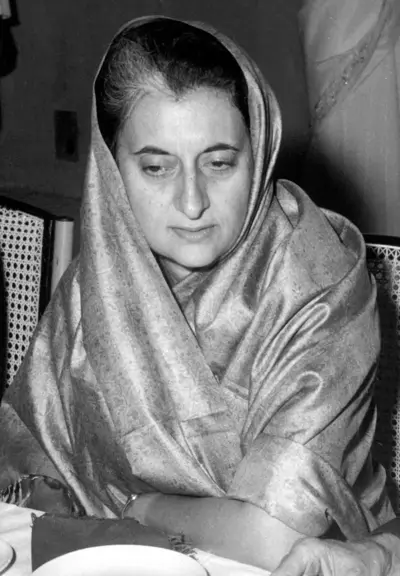
Indira Priyadarshini Gandhi was an Indian politician and a central figure of the Indian National Congress. She was the first and, to date, only female Prime Minister of India. Indira Gandhi was the daughter of Jawaharlal Nehru, the first prime minister of India. She served as prime minister from January 1966 to March 1977 and again from January 1980 until her assassination in October 1984, making her the second longest-serving Indian prime minister after her father.
