Gottfried Wilhelm Leibniz Quotes
I hold that it is only when we can prove everything we assert that we understand perfectly the thing under consideration.
Leibniz, Gottfried Wilhelm. New Essays on Human Understanding. Translated by Peter Remnant and Jonathan Bennett, Cambridge University Press, 1996, p. 367.


Proof in a scientific and mathematical context is very different from the legal concept of proof. For Feynman, proof consisted of both being able to deduce a statement in much the same way as a proof is offered in plane geometry and being able to construct an experiment which will demonstrate the validity (confirm the prediction of what will happen all cases. As a theoretical physicist, most of his proofs were of the mathematical, deductive kind. There are many phenomena in mathematics and science that were, and are, known long before someone was able to offer a proof.


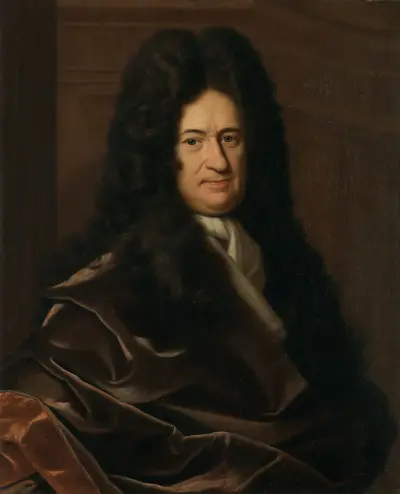
Gottfried Wilhelm (von) Leibniz was a prominent German polymath and one of the most important logicians, mathematicians and natural philosophers of the Enlightenment. As a representative of the seventeenth-century tradition of rationalism, Leibniz developed, as his most prominent accomplishment, the ideas of differential and integral calculus, independently of Isaac Newton's contemporaneous developments. Mathematical works have consistently favored Leibniz's notation as the conventional expression of calculus. It was only in the 20th century that Leibniz's law of continuity and transcendental law of homogeneity found mathematical implementation (by means of non-standard analysis). He became one of the most prolific inventors in the field of mechanical calculators. While working on adding automatic multiplication and division to Pascal's calculator, he was the first to describe a pinwheel calculator in 1685 and invented the Leibniz wheel, used in the arithmometer, the first mass-produced mechanical calculator. He also refined the binary number system, which is the foundation of nearly all digital (electronic, solid-state, discrete logic) computers, including the Von Neumann machine, which is the standard design paradigm, or "computer architecture", followed from the second half of the 20th century, and into the 21st.
