Hubert Humphrey Quotes
I have seen in the Halls of Congress more idealism, more humaneness, more compassion, more profiles of courage than in any other institution that I have ever known.
Hubert Horatio Humphery, 1911-1978, Vice President of the United States (Democrat), Democratic Presidential Nominee, U.S. Senator (Democrat, MN), Speech, Syracuse University, June 6, 1965
Sourced by: Eigen's Political and Historical Quotations


Moses urged them not to accept a compromise what would give them the majority of everything that they were demanding but not all. See {637624} for Rustin’s’ argument to accept the compromise.


Samuel Langhorne Clemens, 1835-1910. Some contemporaries had accused Cleveland of drinking too much but there has never been any evidence of this.


5th Earl of Rosebery


Weltner was the only Georgia politician who urged state compliance with the Federal Civil Rights Law of 1964. (See {637605}.) The others advocated disobedience, crime, and obstruction, particularly the Democratic Party Candidate for Governor Lester Maddox who also advocated racial violence and had a history of it himself. Weltner refused to support Maddox, and the Democratic Party then instituted a loyalty oath for all party candidates where they promised to support and campaign for all party candidates on the ticket. Welter refused to sign the oath and support Maddox, and therefore gave up the Democratic nomination which at the time virtually guaranteed a win. (Soon after, the segregationist politicians of the South accepted the Republican invitation to switch parties and since then the remaining racists and anti-civil rights politicians run as Republicans.


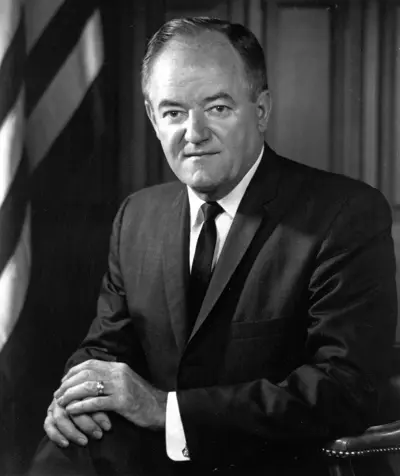
Hubert Horatio Humphrey Jr. was an American politician who served as the 38th vice president of the United States from 1965 to 1969. He twice served in the United States Senate, representing Minnesota from 1949 to 1964 and 1971 to 1978. As a senator he was a major leader of Modern liberalism in the United States. As President Lyndon Johnson's vice president, he supported the controversial Vietnam War. An intensely divided Democratic Party nominated him in the 1968 presidential election. He lost a close race to Republican nominee Richard Nixon.
