J. Edgar Hoover Quotes
I don't read it. I view it like the Daily Worker.
Referring to the Washington Post:. The official newspaper of the American Communist party.
J. Edgar Hoover, 1895-1972, Director, Federal Bureau of Investigation, Phone call with President Lyndon Johnson, November 25, 1963
Sourced by: Eigen's Political and Historical Quotations

In 1948 in the midst of the Red Scare the HUAC and its Senate counterpart had started to hound a former Assistant Secretary of State, Lawrence Duggan. Typical of the times, those who disagreed with Duggan’s political views anonymously leaked material to the press alleging that Duggan might have been a spy. The press had a feeding frenzy and Dugan committed suicide in the midst of the pressure. Most in Congress paused to contemplate the consequence of what was occurring. Even Richard M. Nixon regretted the “misunderstandings.” Dugan’s father, however, an old acquaintance of Edward R. Murrow, the then dean of American broadcasters, however primarily blamed the press for printing all the unsubstantiated rumor and innuendo.

Stalin was very astute in realizing the power of the press and the modern media. As a result, his solution was to not only develop a strong party media apparatus, but deny any contrary groups the fight to press and media. He was so effective at media control that most dictators and theocrats would thereafter model the Russian system of monopoly control over the media.

Nixon had just made a television address explaining why he had asked for the resignations of his two most senior White House aides in the midst of the Watergate scandal. Nixon continued his lies and there were some of his supporters, like Graham, who were still fooled. Note the reference to Ruth—Graham’s wife. Nixon, himself, had been one of the first to perpetuate the Red Scare and blame communists for anything that goes wrong and to smear any critics by calling them communists who were just trying to destabilize the country.


Supporters of medical reform include:
The country that is referred to is the USSR. The "left-wingers" are the Russian advocates of glasnost.

who worked with the Communists. The Communists were to Flip-flop again when Russia needed arms and assistance to fight Hitler when the pact broke down. See {595773}


At the time, one of the favorite right wing accusations that the media were all biased in favor of liberal points of view. Any time a news story was covered that implied or showed that right wing ideology might be wrong, the conservatives would cry “liberal bias” without addressing whether the objection was sound or not. Often the most extreme right wing views are ideological and flaunt reality. Colbert turned this into a very funny phrase.


Until the 20th century almost all American political media were shamelessly and overtly biased—left or right. Political Parties had their own de facto publications much like Fox News became for the Republicans in the 21st century. In the 20th century journalism developed into a profession that evolved standards of objectivity in reporting. That norm then prevailed for about 70 years. With the extreme polarization of the later years of the 29th Century the right wing began to accuse much of the media of a left wing bias, and the media tended to react as Krugman describes in this quotation. The model of having spokespersons for “each side” of an issue works for highly subjective political preferences with a two party system, but where it broke down is with scientific and technical issues. On these, there often really are not two scientific points of view, but there is a scientific consensus of the vast majority of scientists and almost all the prestigious and accomplished scientists are in accord. However, there may be some who have a cultural, religious and/or political concern for some science and its implications for society. They in turn find a scientist or two, often one who is unaccomplished and not recognized in the scientific field to argue a different point of view. The media have tended to equate the two and have a “debate” as if there were two sides to the science when there are not. These issues tend to cluster around scientific medical issues involving sex and birth control methods, environment and conservation, evolution, the age of the earth and the method of creation of the universe. The problem is particularly exacerbated by the general scientific illiteracy of the American population and the relatively few journalists who themselves are scientifically literate who can explain scientific issues well.

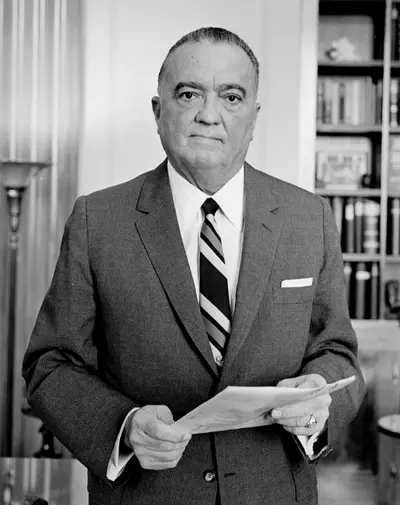
John Edgar Hoover was an American law enforcement administrator who served as the first Director of the Federal Bureau of Investigation (FBI) of the United States. He was appointed director of the Bureau of Investigation – the FBI's predecessor – in 1924 and was instrumental in founding the FBI in 1935, where he remained director for another 37 years until his death in 1972 at the age of 77. Hoover has been credited with building the FBI into a larger crime-fighting agency than it was at its inception and with instituting a number of modernizations to police technology, such as a centralized fingerprint file and forensic laboratories. Hoover is also credited with establishing and expanding a national blacklist, referred to as the FBI Index or Index List, renamed in 2001 as the Terrorist Screening Database which the FBI still compiles and manages.
