Eduard Shevardnadze Quotes
I don't plan to return. I have a lot of unresolved things to do.
Shevardnadze, Eduard. Interview by Julius Strauss. The Daily Telegraph, Telegraph Media Group, 25 Nov. 2003.


There are two ethnic groups in Fiji. The indigenous Fijians and immigrants from India and their descendants. The Indians originally came to trade and represent a globalized, mercantile culture whereas the indigenous tribes did not have the tradition of business. Over time, the minority Indians were economically more successful than the majority, which tended to resent the Indians. As the Indians were the political minority with no strong tradition of protection of minority rights, they became victims of discriminatory behavior in a nation where the traditional political structure of tribal chiefs and tribes dominated politics. Religion also separated the Hindu Indians from the Christian tribals. In the early 21st century, an Indian was elected prime minister, but this led to a revolt and coup by some traditional tribals. Finally the coup was put down but the society had been split apart and there was continuous argument over rights and whether the coups plotters should be punished.
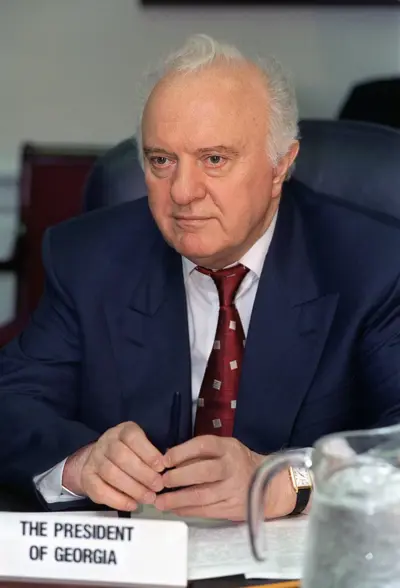
Eduard Ambrosiyevich Shevardnadze was a Georgian politician and diplomat. He served as First Secretary of the Georgian Communist Party (GPC), the de facto leader of Soviet Georgia from 1972 to 1985 and as Minister of Foreign Affairs of the Soviet Union from 1985 to 1991. Shevardnadze was responsible for many key decisions in Soviet foreign policy during the Gorbachev Era including reunification of Germany. Following the dissolution of the Soviet Union, he was President of Georgia (or in equivalent posts) from 1992 to 2003. He was forced to retire in 2003 as a consequence of the bloodless Rose Revolution.
