Theodore Roosevelt Quotes
I do not want to establish the precedent of going about guarded.
President McKinley had just been assassinated in Buffalo, NY. Roosevelt traveled to Buffalo where he took the oath of office. The Buffalo authorities, not wanting to have a second Presidential assassination ordered a detail of police to guard the new President. Remarkably, even a detail of 4 policemen guarding the President was seen by Roosevelt to be an unacceptable precedent. None-the-less, Presidential security was strengthened and formalized for the first time. Roosevelt, personally, carried a revolver—and new how to use it—so was not terribly cooperative with his secret service details, who he would literally run away from and trick them to tumbling over sand dune cliffs on his long Island estate. Despite this, Presidential Security was established during his administration.
Theodore Roosevelt, 1858-1919, 26th President of the United States (Republican, NY), Statement to four policemen who he sent away as he walked from his swearing-in ceremony, September 1901
Sourced by: Eigen's Political and Historical Quotations


In England there was an eye on American McCarthyism and its excesses.

There was no formal Secret Service protection for the president in 1864. The Marshall of the District of Columbia was an old friend of President Lincoln's and he assumed some responsibility for his security. When he heard that the president was planning on attending the theater accompanied only by Senator Charles Sumner and the elderly Prussian minister, the Marshall was disparaging of their defensive abilities.


No male candidate had before or since been asked such a question.

This is a very important quotation in that there are some who believed—then and now—narrowly that self defense is limited to responding to only physical attacks on the United States per se. Kellogg made it clear that it includes attacks on the United States and any of its possessions. Most important it allows response to any “danger” to the United States. By this definition, for example, if Saddam had been developing weapons of mass destruction in the Iraq war, the pre-emptive attack would have been self-defense. Since the claim of weapons development was bogus, it was not self defense. The key variable a reasonable danger. Nations determine that by what others do and say. In 2011, if Iran were developing nuclear weapons the U. S. could attack as an act of self defense because the Iranian highest level officials have called for “death to the United States”. When they just had the intention to harm us, there was no danger. But when they add the means to harm us to the intention, that is a danger. Likewise other nations may act in self defense if a potential enemy threatens to endanger them and has the means to carry out the threats or desires.


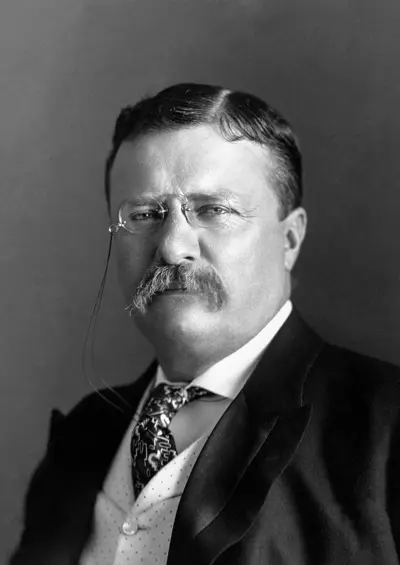
Theodore Roosevelt Jr., often referred to as Teddy or his initials T. R., was an American statesman, conservationist, naturalist, historian, and writer, who served as the 26th president of the United States from 1901 to 1909. He previously served as 33rd governor of New York from 1899 to 1900 and the 25th vice president of the United States from March to September 1901. Roosevelt emerged as a leader of the Republican Party and became a driving force for anti-trust and Progressive policies.
