Gottfried Wilhelm Leibniz Quotes
I do not believe that a world without evil, preferable in order to ours, is possible; otherwise it would have been preferred. It is necessary to believe that the mixture of evil has produced the greatest possible good: otherwise the evil would not have been permitted. The combination of all the tendencies to the good has produced the best; but as there are goods that are incompatible together, this combination and this result can introduce the destruction of some good, and as a result some evil.
Leibniz, Gottfried Wilhelm. Theodicy: Essays on the Goodness of God, the Freedom of Man, and the Origin of Evil. Translated by E. M. Huggard, Routledge & Kegan Paul, 1951, p. 129.


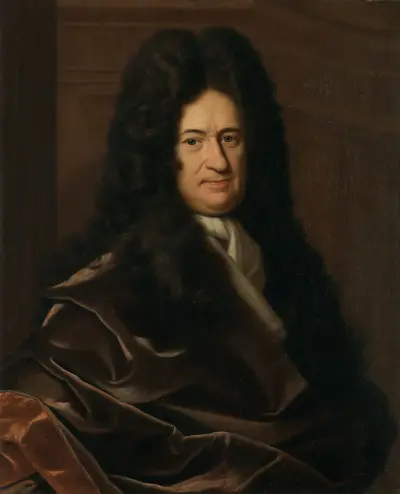
Gottfried Wilhelm (von) Leibniz was a prominent German polymath and one of the most important logicians, mathematicians and natural philosophers of the Enlightenment. As a representative of the seventeenth-century tradition of rationalism, Leibniz developed, as his most prominent accomplishment, the ideas of differential and integral calculus, independently of Isaac Newton's contemporaneous developments. Mathematical works have consistently favored Leibniz's notation as the conventional expression of calculus. It was only in the 20th century that Leibniz's law of continuity and transcendental law of homogeneity found mathematical implementation (by means of non-standard analysis). He became one of the most prolific inventors in the field of mechanical calculators. While working on adding automatic multiplication and division to Pascal's calculator, he was the first to describe a pinwheel calculator in 1685 and invented the Leibniz wheel, used in the arithmometer, the first mass-produced mechanical calculator. He also refined the binary number system, which is the foundation of nearly all digital (electronic, solid-state, discrete logic) computers, including the Von Neumann machine, which is the standard design paradigm, or "computer architecture", followed from the second half of the 20th century, and into the 21st.
