Albert Einstein Quotes
I do not believe in immortality of the individual, and I consider ethics to be an exclusively human concern with no superhuman authority behind it.
Einstein, Albert. Albert Einstein: The Human Side. Edited by Helen Dukas and Banesh Hoffmann, Princeton University Press, 1979, p. 39.


By morally subjugating the existing laws, the scriptures, public opinion to the law of nature, Spinoza distressed many of the clerics and civil authorities of the day. Spinoiza's views were so threatenting to the established religious authorities that he was the only man in history to have been excommunicated by the Jews, the Catholics and the Muslims.

This is a very good quotation showing the point of view of religious fundamentalists that if there is no fixed statement of ethics and morality as with the word of God as revealed in the Bible, what then makes anything right or wrong and the world exists in a moral behavioral vacuum. Other religionists hold that the morality is in the metaphors and philosophy of religion and not in the literal words of scripture. Still others argue that morality and religion itself is dynamic and is constantly changing. Then there are those who build their view of morality on philosophy but which is not based on a deity—Ethical Culturalists for example {592791}. Also, there are the pragmatic evolutionists who argue that cooperative behavior has evolved in man and cultural rules—morality—is also transmitted by culture and systems of law.


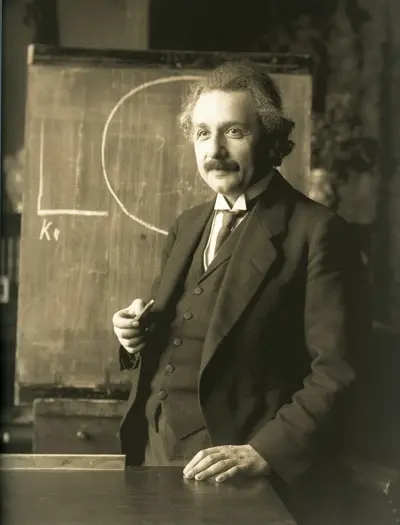
Albert Einstein was a German-born theoretical physicist, widely acknowledged to be one of the greatest physicists of all time. Einstein is known for developing the theory of relativity, but he also made important contributions to the development of the theory of quantum mechanics. Relativity and quantum mechanics are together the two pillars of modern physics. His mass–energy equivalence formula E = mc2, which arises from relativity theory, has been dubbed "the world's most famous equation". His work is also known for its influence on the philosophy of science. He received the 1921 Nobel Prize in Physics "for his services to theoretical physics, and especially for his discovery of the law of the photoelectric effect", a pivotal step in the development of quantum theory. His intellectual achievements and originality resulted in "Einstein" becoming synonymous with "genius".
