Thomas Paine Quotes
I die in perfect composure and resignation to the will of my Creator, God.
Paine, Thomas. "Letter to Andrew Dean (August 15, 1806)." The Writings of Thomas Paine, edited by Moncure Daniel Conway, vol. 4, G.P. Putnam's Sons, 1896, p. 421.


Wallace had asked him about rumors that he would be harmed by the followers of the Nation of Islam for criticizing the leader’s sexual behavior with staff. Malcolm X was assassinated shortly thereafter.

Benton hated John Calhoun, and when the latter died, a reporter asked Benton if he cared to make any comment about his departed Senate colleague. Benton replied:

Charles was a young man who ruled under the thumb of his mother, Catherine de Medici. She and the leading Catholic political figures had decided to have the army massacre the Huguenots—Protestants—of France. Charles knew the massacre was to begin that night and tried to save his friend Rochefoucault, a Protestant, who was a member of the King’s court. He suggested several times that Rochefoucault not go home that evening but stay at the Louvre. The unsuspecting Rochefoucault felt that he had to get home to his wife and left explaining that to the King. Hence the King’s remark. Rochefoucault and his family were murdered that night. In the end, 50,000 Protestants were massacred in what has come to be known as the Massacre of Saint Bartholomew. Many of the palace servants were Protestants and were cut to ribbons throughout the palace. The King from a palace window shot a rifle at Protestants trying to swim the River Seine to escape, while his page kept reloading for him.


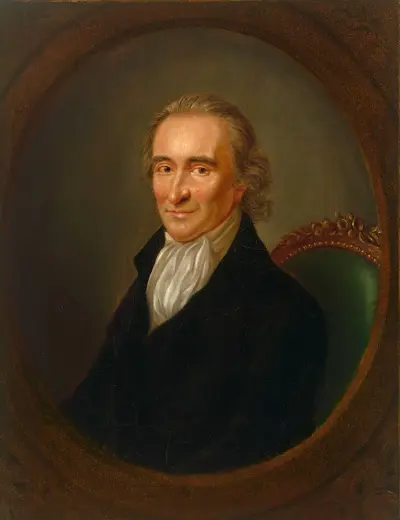
Thomas Paine was an English-born American political activist, philosopher, political theorist, and revolutionary. He authored Common Sense (1776) and The American Crisis (1776–1783), the two most influential pamphlets at the start of the American Revolution, and helped inspire the patriots in 1776 to declare independence from Great Britain. His ideas reflected Enlightenment-era ideals of transnational human rights. Historian Saul K. Padover described him as "a corsetmaker by trade, a journalist by profession, and a propagandist by inclination".
