Michael J. Quill Quotes
I believe in the Corporal Works of Mercy, the Ten Commandments, the American Declaration of Independence and James Connolly’s outline of a socialist society… Most of my life I’ve been called a lunatic because I believe that I am my brother’s keeper. I organize poor and exploited workers, I fight for the civil rights of minorities, and I believe in peace. It appears to have become old-fashioned to make social commitments — to want a world free of war, poverty and disease. This is my religion
Michael J. Quill, 1905-1966, President and Founder, Transport Workers Union of America, Member of the New York City Council (American Labor Party), Quoted in Manus O’Riordan, Following in the Footsteps of Connolly, 2002
Sourced by: Eigen's Political and Historical Quotations


Most people associate the phrase with the 1963 march in which Randolph was one of the organizers and leaders. However, he first used the term in 1941 threatening President Roosevelt with a protest march in the middle of WWII unless Roosevelt ordered the discrimination in defense industries and the military to cease. FDR and his administration did much to improve the situation but came far short of equality. Randolph organized the March on Washington Movement in 1941 and in negotiations throughout the war, this was his trump card. Progress was made but slowly. Randolph maneuvered a fine line as he wanted to do nothing to hurt the war effort. Some severely criticized Randolph’s tactics which were quite effective. Finally in 1963, 22 years after Randolph had first threatened such a march, it finally took place, leading to the Civil Rights Act of the following year. See {625657} for a Southern racist description of Ranolph’s techniques and his victories.


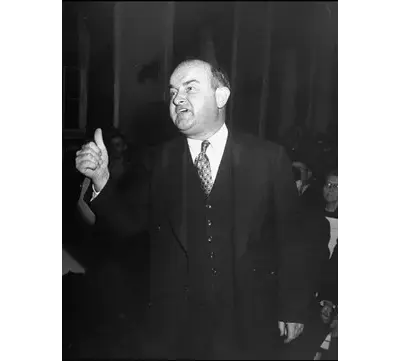
Michael Joseph "Red Mike" Quill was one of the founders of the Transport Workers Union of America (TWU), a union founded by subway workers in New York City that expanded to represent employees in other forms of transit and the President of the TWU for most of the first thirty years of its existence. A close ally of the Communist Party USA (CP) for the first twelve years of his leadership of the union, he broke with it in 1948.
