Samuel Johnson Quotes
I am willing to love all mankind, except an American.
Samuel Johnson, 1709-1784, English Writer & Lexicographer, Boswell's The Life of Samuel Johnson, LL.d. April 15, 1778
Sourced by: Eigen's Political and Historical Quotations


Disraeli was the 1st Earl of Beaconsfield


The Kansas City Public Libraryhad been vandalized in the wake of the Donald Trump victory in the 2016 Presidntial race. Almost all of the racist, white supremicist, and Nazi organizations and their members were Trump supporters although Mr. Trump denied that he had ever overtly solicited their support, However hia frequent racist and misoginistic remarks attracted frings groups and people who had never before endorsed an American major party Presidential candidate. After Trups victory there was a large increase in the nunber of racist, religious and ethnic attacks against people and property, despite the fact that Trump had appeared on 60 Minutes and told these extremsits in no uncertain terms to "Stop". Neo Nazis and other White Supremecists generally do not with shows like 60 minutres however, and Trump and his staff made little effor to communicate Trums message through the vehicles that they communicagte through.


Constantine the Great. Roman Emperors saw Christians as their most dangerous foes. However, Constantine converted to Christianity and ceased the vicious persecution of the Christians. As politicians in many societies need scapegoats to blame for various problems, and the Christians were no longer available, the Jews then became the targeted scapegoats.

At the time, General Flynn was campaigning as a part of the Donald Trump Campaign Team. There was a great deal of Islamaphobia and Flynn and Trump thoght that given the history of Radical Islamic Brutality and Gross Violence, the rear was reasonable. Critics however pointed out that while some Southernors were still violent White Supremicists leaders should not encoruage a fear of Southerners. They argue that the fear should be of extreme radical Muslims, and not Muslims in general. The generalization of fear to all people of any group for the actions of a small subset of the group is actually dangerous and leads to prejudice, feal, hate and often violence such as when many American Blacks feared all pol;ice in the beginning of the 21st century becasue dozens of police officers short and killed unarmed black men,, or the West Cast American fear of the Japanese in WWII, or the terrible result--the Holocaust-- of many Germans' fear and hate of Jews for the "trangressions" of some. All human groups have some bad souls within the greater body of good people--including Muslims.


See {401426} for more on his view of nationality and nationalism.


Many people have believed that the Nazis introduced anti-Semitism into German society and politics. This quotation is one of the very many what show that anti-Semitism was rife in Germany before Hitler ever came to power—back to the Dark Ages. The Nazis recognized it and took advantage of it by ascribing all of Germany’s ills to the Jews, knowing full well that there was underlying public opinion that would make that a good tactic.


After the war Donitz was found guilty of Unrestricted Submarine Warfare and using thousands of slave laborers in his shipyards. He was sentenced to 10 years, one of the lightest sentences if the German War Crimes Trials.


Vladimir Lenin. Despite Lenin’s abhorrence of anti-Semitism, there were any other Russians for whom it was normal. After Lenin’s death, Stalin and his henchmen used anti-Semitism to divert attention from the Communist Party’s failure to meet its economic and other goals.
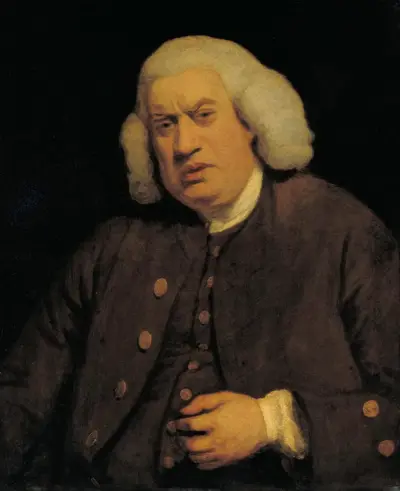
Samuel Johnson, often referred to as Dr Johnson, was an English writer who made lasting contributions to English literature as a poet, playwright, essayist, moralist, literary critic, biographer, editor, and lexicographer. Religiously, he was a devout Anglican, and politically a committed Tory. The Oxford Dictionary of National Biography describes Johnson as "arguably the most distinguished man of letters in English history". He is the subject of James Boswell's The Life of Samuel Johnson, described by Walter Jackson Bate as "the most famous single work of biographical art in the whole of literature".
