Martin Luther Quotes
I am much afraid that the schools will prove the very gates of hell, unless they diligently labour in explaining the Holy Scriptures, and engraving them in the hearts of youth. I advise no one to place his child where the scriptures do not reign paramount. Every institution in which means are not unceasingly occupied with the Word of God must be corrupt.
Luther, Martin. Luther's Works, Volume 44: The Christian in Society I. Edited by James Atkinson, Fortress Press, 1966, p. 207.

With the exception of a few theocracies, the power to set standards of education is claimed by virtually every government in the world. Some national governments have traditionally delegated some or much of the power to state, regional or local governments. The United States has been one of the rare exceptions. The words “education” or “schools” never even appear once in the U. S. Constitution. Therefore, in the U. S. the power belongs with the state governments. (Recently with “No Child Left Behind” the U. S. Federal government has been involved in educational standards setting.) This quotation is used by many as a classic example of a practice of many right wing fundamentalist Christians and Jews who extrapolate from the Bible to determine which legislation God wants or opposes. Most Christian and Jewish clerics and theologians however reject this notion and have a more modern view of the role of God in the democratic political process. Both the United States and Canada have very small minorities who hold the Stockwell Day position. On difference however is that in the United States, such extreme fundamentalists rarely enter or succeed in politics.


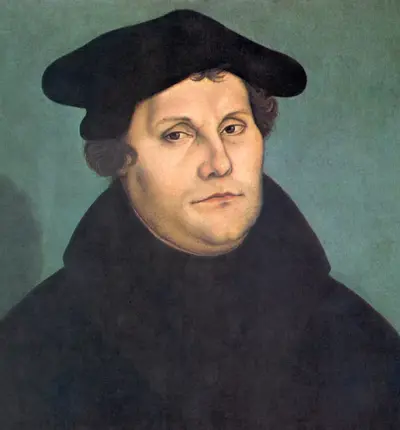
Martin Luther, O.S.A. was a German professor of theology, priest, author, composer, Augustinian monk, and a seminal figure in the Reformation. Luther was ordained to the priesthood in 1507. He came to reject several teachings and practices of the Roman Catholic Church; in particular, he disputed the view on indulgences. Luther proposed an academic discussion of the practice and efficacy of indulgences in his Ninety-five Theses of 1517. His refusal to renounce all of his writings at the demand of Pope Leo X in 1520 and the Holy Roman Emperor Charles V at the Diet of Worms in 1521 resulted in his excommunication by the pope and condemnation as an outlaw by the Holy Roman Emperor.
