Alcuin Quotes
How few care about such things.
Even then most students did not want to study mathematics.
Alcuin [Flaccus] of York, ~735-804, English Scholar & Abbot Referring to Geometry, Quoted in David Levering Lewis, God’s Crucible, 2008
Sourced by: Eigen's Political and Historical Quotations


When Moynihan was U. S. Chief Delegate he was chided by the Soviet delegate to "take care" for his strong rhetoric lest he offend other nations.


The President was with the way the press had handled some press releases from the White House and wanted to give the press less information.


There are a few conflicts between the legislation to protect the border by using vehicles and building facilities and protecting the endangered species that might be in the area. These were worked out by allowing the Border Patrol, if they thought there was a serious boarder problem, to make the decision of how to proceed but in the general cases to balance off the costs and benefits to border guarding and the endangered species and wilderness. Chaffetz was a rabid anti environment advocate who opposes almost all accommodations for endangered speices. Such extreme statements as these, produces an opposite extreme reaction on the part of some environmentalists who will make no compromise even if benign, as they believe that CHaffetz and the few others who think like he, will then gut the entire legislation as they are not acting in good faith. The result is a polarization in which the extreme’s fight it out and the reasonable middle ground is ignored.
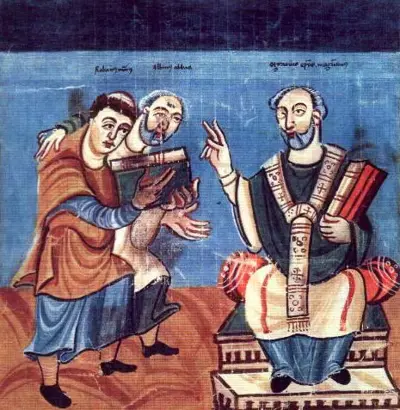
Alcuin of York – also called Ealhwine, Alhwin, or Alchoin – was an English scholar, clergyman, poet, and teacher from York, Northumbria. He was born around 735 and became the student of Archbishop Ecgbert at York. At the invitation of Charlemagne, he became a leading scholar and teacher at the Carolingian court, where he remained a figure in the 780s and 790s. "The most learned man anywhere to be found", according to Einhard's Life of Charlemagne (c. 817–833), he is considered among the most important intellectual architects of the Carolingian Renaissance. Among his pupils were many of the dominant intellectuals of the Carolingian era.
