Milton Friedman Quotes
History suggests that capitalism is a necessary condition for political freedom. Clearly it is not a sufficient condition.
Milton Friedman, 1912-2006, 1912-2006, Nobel Laureate in Economics, Capitalism and Freedom, 1962
Sourced by: Eigen's Political and Historical Quotations


At the time, land was much more of a necessity for the average person than today in America. But in early America and much of the rest of the world today, without land one had little or no opportunity to do almost anything. So equality of land distribution was necessary for equality of opportunity. America never solved the problem of equality of land distribution; we just developed an economy where land was not longer so critical to opportunity.


The Grammar Curmudgeon

Many of the far left grew disillusioned with the British Labor Movement and how it was relating to the capitalist companies, the government, and the workers. The Unions had become very undemocratic and controlling with the government pressuring both labor and companies to the degree that many felt that the institutions themselves were no longer free institutions. Ironically, they preferred the open competition of the American system at the time where unions and companies were free to fight out their differences.

See {585465} and {585466} for a similar view.


He was answering a question of why many people in Eastern Europe were not more enthusiastic about their freedom and democracy.

Alexander Dubcek, Communist leader of Czechoslovakia, had pushed reform so far that 5 Soviet armies invaded. Dubcek was brought to Russia where he tried to persuade the Russian premier that the invasion was contrary to the principles of socialism.


In 1881 this view was that of a radical political outlier. In the first decades of the 21st century, this was a generally acceptable political viewpoint held by members of both major political parties.

Despite opposition of the dominant Communist Party, she had been elected 7 times in a row. She was one of the few non-communist deputies.
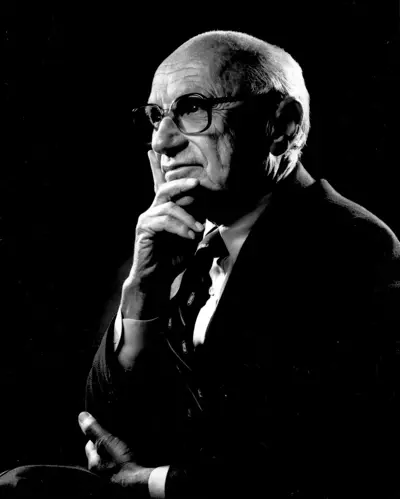
Milton Friedman was an American economist and statistician who received the 1976 Nobel Memorial Prize in Economic Sciences for his research on consumption analysis, monetary history and theory and the complexity of stabilization policy. With George Stigler and others, Friedman was among the intellectual leaders of the Chicago school of economics, a neoclassical school of economic thought associated with the work of the faculty at the University of Chicago that rejected Keynesianism in favor of monetarism until the mid-1970s, when it turned to new classical macroeconomics heavily based on the concept of rational expectations. Several students and young professors who were recruited or mentored by Friedman at Chicago went on to become leading economists, including Gary Becker, Robert Fogel, Thomas Sowell and Robert Lucas Jr.
