Christopher Marlowe Quotes
Hell hath no limits, nor is circumscribed in one self place; for where we are is Hell, and where Hell is, there must we ever be.
Christopher Marlowe, 1564-1593, English Poet and Playwright, The Tragical History of Dr. Faustus
Sourced by: Eigen's Political and Historical Quotations


Action he advocated to his followers who attacked and killed pro-slavery advocates in Kansas. The civil war of Kansas was over whether Kansas would enter the Union as a slave state of a free state. If a free state, the free states would be able to block further slavery. If Kansas were to become a slave state, the slave states would have a sufficient majority to make all future expansion hospitable to slavery. The slavery forces started sending man and families into Kansas so that they could vote; the abolitionists did the same. Both sides armed and a war began with each faction trying to kill or drive the other faction out of Kansas before the vote. See {617388} and {612516}.


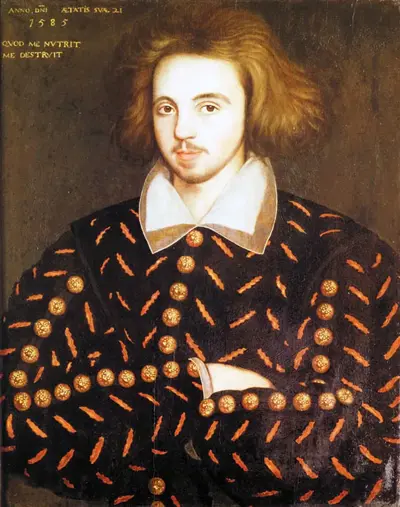
Christopher Marlowe, also known as Kit Marlowe, was an English playwright, poet and translator of the Elizabethan era. Modern scholars count Marlowe among the most famous of the Elizabethan playwrights; based upon the "many imitations" of his play Tamburlaine, they consider him to have been the foremost dramatist in London in the years just before his mysterious early death. Some scholars also believe that he greatly influenced William Shakespeare, who was baptised in the same year as Marlowe and later succeeded him as the pre-eminent Elizabethan playwright. Marlowe was the first to achieve critical notoriety for his use of blank verse, which became the standard for the era. His plays are distinguished by their overreaching protagonists. Themes found within Marlowe's literary works have been noted as humanistic with realistic emotions, which some scholars find difficult to reconcile with Marlowe's "anti-intellectualism" and his catering to the taste of his Elizabethan audiences for generous displays of extreme physical violence, cruelty, and bloodshed.
