Benjamin Franklin Quotes
He that is of the opinion money will do everything may well be suspected of doing everything for money.


In 1811 Calhoun was a freshman congressman. Congress was considering raising 10,000 men to resist the encroachments of Great Britain. The large cost of the enterprise was preventing the measure from passing. Calhoun objected to considering the cost factor at all:


The president was himself an evangelical Christian and he had gone out of his way to issue executive orders authorizing payments to be made for church operated social service activities where proselytizing was permitted. Many Americans thought bush had jumped over the wall separating church and state and yet some of the evangelical Christians kept insisting on more and more money.


See {625339} and {622808} for similar conservative views.

Actually he also blamed the students who had become very active in politics in disgust with the corrupt politicians. But the students could block things but were not able to constructively come up with any alternatives. See {613112}.


See Oliver Stone {625339} for a modern, popular culture, icon of this idea. Several years after this interview, Black, with business interests in several countries, was convicted and served a jail sentence in the United States for fraud. His greed got the best of him.
There was a great deal of war profiteering during the American Revolution and Gerard thought that this was a negative indicator of prospects for America. Things actually got worse during the war of 1812 where there was war profiteering also and many in New England profited from selling supplies to the British enemy. Unfortunately, taking economic advantage of a wartime crisis has accompanied virtually every war in which we have become engaged. In WWII, the automobile industry virtually blackmailed the government into high profits if they would produce war material instead of cars, and the rapaciousness of Haliburton in the Iraq war became a national scandal. See George Washington’s comment on the time {624228}.
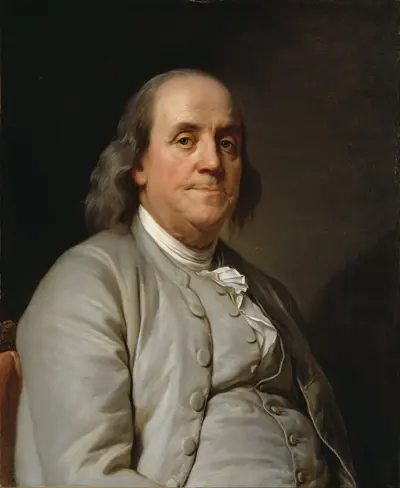
Benjamin Franklin FRS FRSA FRSE was one of the Founding Fathers of the United States. A polymath, he was a leading writer, printer, political philosopher, politician, Freemason, postmaster, scientist, inventor, humorist, civic activist, statesman, and diplomat. As a scientist, he was a major figure in the American Enlightenment and the history of physics for his discoveries and theories regarding electricity. As an inventor, he is known for the lightning rod, bifocals, and the Franklin stove, among other inventions. He founded many civic organizations, including the Library Company, Philadelphia's first fire department, and the University of Pennsylvania.
