Peter Singer Quotes
Google has withdrawn from China, arguing that it is no longer willing to design its search engine to block information that the Chinese government does not wish its citizens to have. In liberal democracies around the world, this decision has generally been greeted with enthusiasm.
Singer, Peter. "Google's Chinese Lesson." Project Syndicate, 8 Feb. 2010.


This seemingly logical inconsistency is actually typical of many nations and cultures that practice censorship. Freedom in this is a concept of a limited freedom—limited to what is reasonable, not harmful, not offensive. So all are free to behave within a circumscribed set of norms. By this logic, freedom is not being curtailed if the state acts to stop activity beyond those norms. Every nation accepts this principle to some extent. In America one “cannot should fire in a crowded theater” but there are very few other restrictions. But in Germany, Israel and other modern Industrial democracies there is censorship of material that promotes ethnic hatred whereas in the U. S. that is protected from censorship. In China many sites on the Internet have material that is regarded as inflammatory, or slanders the government and this is bad because people might lose confidence in their government. So freedom of speech and censorship issues are matters of degree with the United State being at one end of the scale and North Korea and Saudi Arabia being at the other end. China has been moving from the North Korean end of the scale towards the middle.


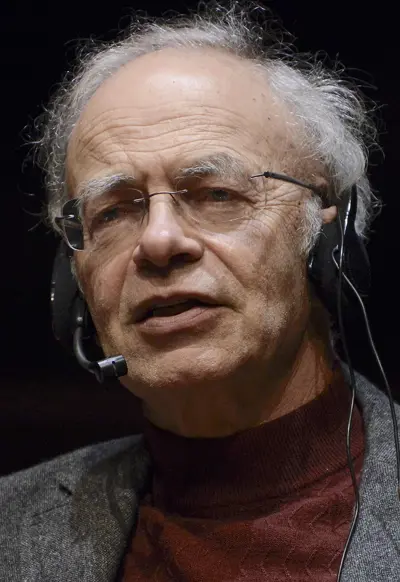
Peter Albert David Singer AC is an Australian moral philosopher, currently the Ira W. DeCamp Professor of Bioethics at Princeton University. He specialises in applied ethics and approaches ethical issues from a secular, utilitarian perspective. He is known in particular for his book Animal Liberation (1975), in which he argues in favour of veganism, and his essay "Famine, Affluence, and Morality", in which he argues in favour of donating to help the global poor. For most of his career, he was a preference utilitarian, but he stated in The Point of View of the Universe (2014), coauthored with Katarzyna de Lazari-Radek, that he had become a hedonistic utilitarian.
