Thomas Aquinas Quotes
Good and evil are essential differences of the act of the will. For good and evil pertain essentially to the will; just as truth and falsehood pertain to the reason, the act of which is distinguished essentially by the difference of truth and falsehood (according as we say that an opinion is true or false.) Consequently, good and evil volition are acts differing in species.
Aquinas, Thomas. The Summa Theologica of St. Thomas Aquinas. Translated by Fathers of the English Dominican Province, Benziger Brothers, 1947, I-II, Q. 18, Art. 5.


It was Spinoza’s insistence that man should be free and use reason rather than faith and not to adhere to authority that got him excommunicated by the Jews, The Catholics and the Muslims, the only such man in history. Authority per se was evil if it was listened to.


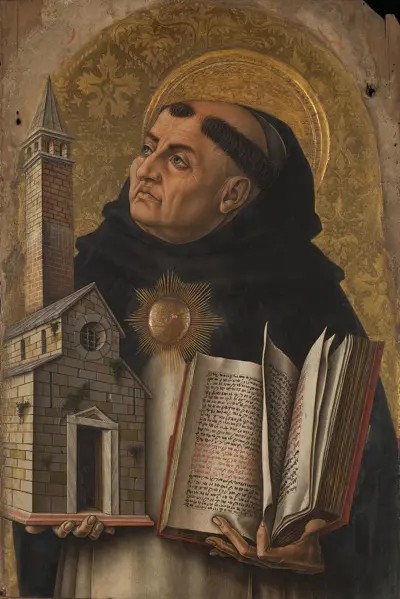
Thomas Aquinas was an Italian Dominican friar, philosopher, Catholic priest, and Doctor of the Church. An immensely influential philosopher, theologian, and jurist in the tradition of scholasticism, he is also known within the latter as the Doctor Angelicus, the Doctor Communis, and the Doctor Universalis. The name Aquinas identifies his ancestral origins in the county of Aquino in present-day Lazio, Italy. Among other things, he was a prominent proponent of natural theology and the father of a school of thought (encompassing both theology and philosophy) known as Thomism. He argued that God is the source of both the light of natural reason and the light of faith. His influence on Western thought is considerable, and much of modern philosophy developed or opposed his ideas, particularly in the areas of ethics, natural law, metaphysics, and political theory.
