Mo Ibrahim Quotes
For every bribe-taker, there must be a bribe-giver, and these givers are all too often from the rich countries. These firms are enabling corruption, crippling or even killing off vulnerable states.
The companies usually argue that bribery is the custom of the Third World nation, and that business cannot realistically be done without bribery. So the situation gets worse and worse and destroys the economies of vulnerable counties. United State corporations are prohibited by law from giving bribes in foreign countries, but many hire middle men to do the bribing anyway. Even major companies like General Electric have been convicted of bribing foreign officials.
Mo Ibrahim, Sudanese Entrepreneur, Industrialist, and Philanthropist, “Who Else Is to Blame”, Foreign Policy, July/August, 2010
Sourced by: Eigen's Political and Historical Quotations


He began an anti-corruption campaign, that executed many and jailed thousands. However, the Chinese Party Council has more billionaires than any other national legislature in the world. Most of these fortunes were made via corruption; these high level figures and those of the army by 2014 were not prosecuted. However, it was a start.

Bribing Congressmen was quite common. In those days, money to Congressmen and Senators was not even disguised as campaign contributions. The letters were the short terms for the different agents.


ANWR stands for the Alaska National Wildlife Reserve. The oil companies want to drill for oil in the reserve and feel that the risk to the pristine natural area is justified by the value of the oil to the nation. At the beginning of their efforts, they maintained that drilling was "no risk" to the environment. However, after the BP oil spill that did so much damage and could not be controlled for months, most oil companies admit there is some risk, but argue that the benefit is worth it. Opponents do not think the benefit is sufficiently great to risk the wildlife and the rest of the ecology, and some argue that the oil itself is just more fossil fuel that will increase the rate of global warming. The “legal bribery” to which President Carter refers is the loophole in the existing laws and rules of trhe House and Senate which allow members to take money from companies or rich individuals and in return give special access to them and their staffs, provide them with early copies of proposed legislation of committee reports, allows them to draft laws or amendments or statements for their speeches, supports their bids for government contracts, makes inquiries to government agencies on the company’s behalf and provides other services that the company executives will bring them more money that the “campaign contributions” cost them.


Today, we assume that corporations including banks chartered by State and Federal governments would hire lobbyists and use their money for political elections. However, in 1833, that was so shocking to public morality that the President addressed it in his State of the Union Address and it was the subject of countless debate. Interestingly, the body politic was equally, if not more, shocked by the fact that the Bank was trying to manipulate public opinion. Jackson and the politicians of that day would take a very dim view of corporate activities today.


Abramoff had bribed over 100 Congressional offices by a combination of campaign donations, paid golf junkets all over the world, free elegant meals at his own fancy Washington Restaurant, free tickets for the Congressmen, their staffs and their major constituents, to Concerts and sporting events including his own Skyboxes, and promises of future employment at very high salaries. Ironically, we was convicted of cheating some of his lobbying clients and did a jail term, but his “bribery” was technically usually legal. In addition to Abramoff, only one Congressman was charged and convicted of corruption, when many if not most had engaged in these corrupt practices. Congress makes the rules with loopholes so that what is bribery and corruption in any other setting is often not against the law if Congress is involved.


It took until the Presidency of Theodore Roosevelt until monopolies were regulated. Like many of the rapacious businessmen of his era, bribery of public officials was so common that he had no problem admitting this to a reporter who was interviewing him. His father Cornelius, one of the great, creative industrialists of America, was not at all of the same mindset or the same corrupt character and saw corporations and the Railroads as having an important role in America with substantial obligations to the society which enabled the economic development and supported the railroads. He described his son as a “blockhead”. William goes down in American history as the arrogant industrialist and capitalist whose wealth was produced by his talent of being born to the right father who built the great empire. At that time the bribery of members of Congress was direct with cash going directly into their pockets, unlike modern times where it is indirect in the form of Campaign contributions.


In the early 20th century, the corruption in America was much worse than it is today. At the time, it was very common for members of Congress and State Legilators to take bribes from corporations whose interests they protected. Franchises, subsidies and other forms of corporate welfare was much more common. The reforms of the 20th centuries eliminated much of the corruption. At the same time, Americans, including Ms. De Cleyre knew much less about the details of foreign country’s foibles and weaknesses. So she underestimated the degree of corruption of foreign nations and made her judgment from the extensive corruption that then existed in the United States.

Mises is one of the very few economic conservatives who opposed companies getting involved with lobbying or politics in any way. He, like some others, saw the negative public effect that business produces when it does get deeply involved in politics, but he uniquely observed that the businesses themselves suffered as a result of the involvement in politics. Obviously very few business leaders of the 21st century agreed with Mises’ earlier views.


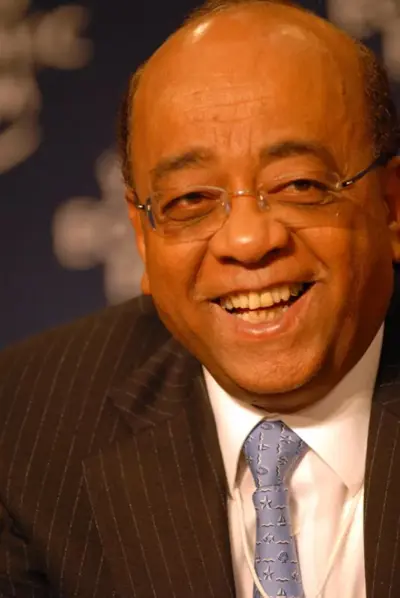
Mohammed "Mo" Ibrahim is a Sudanese-British billionaire businessman. He worked for several telecommunications companies, before founding Celtel, which when sold had over 24 million mobile phone subscribers in 14 African countries. After selling Celtel in 2005 for $3.4 billion, he set up the Mo Ibrahim Foundation to encourage better governance in Africa, as well as creating the Ibrahim Index of African Governance, to evaluate nations' performance. He is also a member of the Africa regional advisory board of London Business School.
