Joseph Stalin Quotes
Everyone imposes his own system as far as his army can reach.
Djilas, Milovan. Conversations with Stalin. Translated by Michael B. Petrovich, Harcourt, Brace & World, 1962, p. 114.


This was not the ravings of a right wing extremist. It was normative for Prussia as a whole. Right wing extremism as we think of it today was the norm of the ruling classes in Prussia and other parts of Germany. This book was a best seller in Germany. This quotation illustrates the mentality of the conservative, militarist, culture that dominated Germany at the time. The German aggression of WWI was not even considered as immoral but a God-given right.

William the Conqueror. The King had come ashore and fell forward in the sand on his face and hands. Showing a sense of humor, he hade this statement. Shortly thereafter he took England militarily at Hastings and seized it politically.

after Isabella’s & Ferdinand’s death. When he was Viceroy after the monarchs, he put down an attempt by some of the nobles to gain control when they asked by what authority he functioned, now that the monarchs who appointed him were dead.


Johansson is describing the origin of the word “hegemony.” During the 5th Century B.C. Athens and their allies formed the Delian League to combat the Persian Empire. Athens, as the most powerful city-state in Ancient Greece, controlled the alliance and the League soon turned into the Athenian “empire” or “hegemony.”

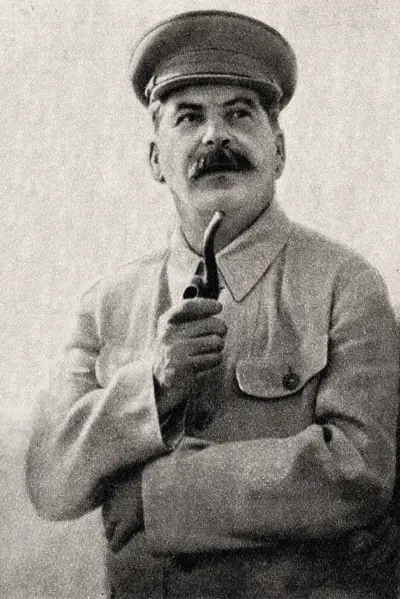
Joseph Vissarionovich Stalin was a Georgian revolutionary and the ruler of the Soviet Union from 1927 until 1953. He served as both General Secretary of the Communist Party of the Soviet Union (1922–1952) and Chairman of the Council of Ministers of the Soviet Union (1941–1953). Despite initially governing the country as part of a collective leadership, he ultimately consolidated power to become the Soviet Union's de facto dictator by the 1930s. A communist ideologically committed to the Leninist interpretation of Marxism, Stalin formalized these ideas as Marxism–Leninism while his own policies are known as Stalinism.
