Roland Barthes Quotes
Ensnared in his starvation, Chaplin-man is always just below political awareness. A strike is a catastrophe for him because it threatens a man truly blinded by his hunger; this man achieves an awareness of the working-class condition only when the poor man and the proletarian coincide under the gaze (and the blows) of the police.
Barthes, Roland. Mythologies. Translated by Annette Lavers, Hill and Wang, 1972, p. 40.


She was writing about the textile mills of Manchester, England in the Industrial Revolution. Workers’ wages were so low that many of them could not feed themselves and their family decently

This fascinating quotation is very frequently quoted out of context. For example even in modern times some Southern slavery apologists quote this passage stating that Adams saw no moral difference between slavery and employment of the lower classes. And anti-capitalists have claimed that this was an attack on capitalism as no better than slavery for many workers. Neither is true. The debate was on the head taxes that states should pay to the central government. Southerners were claiming that they should not have to pay per person taxes on slaves. Adams position was that they should pay in that there is no practical difference in the work and working conditions very often. If slaves should be exempted from the head tax, so should the poor, lower class workers like the fisherman in New England. He always maintained at huge moral difference between a poor free worker and a slave even thought their working conditions might be similar.


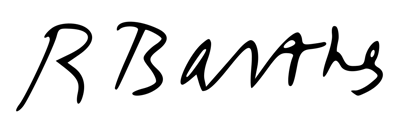
Roland Gérard Barthes was a French literary theorist, essayist, philosopher, critic, and semiotician. Barthes' ideas explored a diverse range of fields and he influenced the development of many schools of theory, including structuralism, semiotics, social theory, design theory, anthropology and post-structuralism. He was particularly known for developing and extending the field of semiotics through the analysis of a variety of sign systems, mainly derived from Western popular culture.
