Haruki Murakami Quotes


Do you know what ‘Sputnik’ means in Russian? ‘Travelling companion’. I looked it up in a dictionary not long ago. Kind of a strange coincidence if you think about it. I wonder why the Russians gave their satellite that strange name. It’s just a poor little lump of metal, spinning around the Earth.


Citations

Murakami, Haruki. Sputnik Sweetheart. Translated by Philip Gabriel, Knopf, 2001, p. 11.

Related Quotes

Several weeks before the Russians launched Sputnik, our team at the Jet Propulsion Laboratory asked permission to place a rocket in orbit around the Earth. We could to it with two days of preparation. We had been doing experiments with 2 stage rockets to test materials and designs for nose-cones returning from space. We launched rockets straight up. At the maximum height we turned it around and fired the second stage to drive it straight back to Earth so it could achieve the speed of an object returning from space. We were developing more and more powerful second stage rockets. We had just calculated that our newest second stage had more than enough thrust to, after the ascent, turn the rocket at right angles to the perpendicular, and fire the rocket into orbit around the earth. We could do this easily. The military were initially very enthusiastic. America could be the first nation that put a satellite in orbit. However, the authorities in Washington, not only refused us permission to try, but postponed a number of our regular launches and forbade us from talking to anyone about our capability or request for our experiment.. When Sputnik was launched into orbit a few weeks later, we were really puzzled. No one ever explained why Washington had refused us permission, but we came up with a theory: The issue of the legality under international law of one country having its satellite in orbit over another country’s airspace was not at all settled. If we did satellite reconnaissance in the future over the Soviet Union, the Russians could claim that was an act of war. And we had extensive plans to create such satellites and launch them when we solved all the technical problems in the future. We believe that the authorities knew that the Russians were about to launch Sputnik. By allowing them to be the first to launch, it would be they—not us—who would be setting the precedent of sending satellites over other nation’s airspace and claiming this was not aggression or an act of war as they thought they were way ahead of us. In addition, after WWII, President Eisenhower was having difficulty getting Congress to spend money on rocketry and satellites as well as science and technology including science and mathematics education which was then terrible in America. So allowing the Russians to “beat us” the administration had the issue that they needed, and they allowed the Russians to set the legal precedents that they would have opposed if we were ahead of them and orbited a satellite first. Either President Eisenhower and his team were brilliantly shrewd or they were pretty dumb because we easily could have put our rockets in orbit then.


Dr. Snyder was the youngest physicist at Los Alamos working on the Atom Bomb Manhattan Project. His rocketry skill was used to fire probes into the highly radioactive area to obtain samples and measurements immediately after the test bomb was exploded.


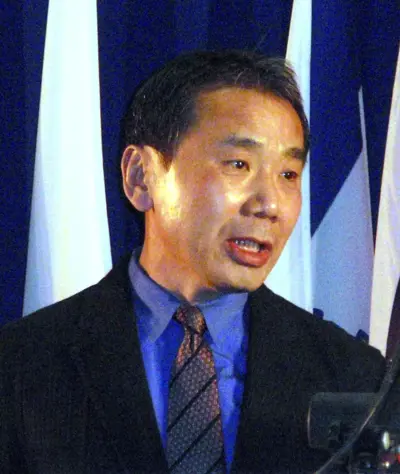
Haruki Murakami
Haruki Murakami
  • Born: January 12, 1949
  • Nationality: Japanese
  • Profession: Novelist, Short-story Writer, Essayist, Translator

Haruki Murakami is a Japanese writer. His books and stories have been bestsellers in Japan as well as internationally, with his work being translated into 50 languages and selling millions of copies outside his native country. His work has received numerous awards, including the World Fantasy Award, the Frank O'Connor International Short Story Award, the Franz Kafka Prize, and the Jerusalem Prize.