Samuel Johnson Quotes
Difficult do you call it, Sir? I wish it were impossible.
Seward, William. Anecdotes of Some Distinguished Persons. Vol. 4, T. Cadell and W. Davies, 1796, p. 15.


He was not supported and a peace was negotiated with the British. De la Rey became a Senator and later was shot while trying to organize another rebellion.

Builder of over 90 percent of the U. S. Navy World War II Boats. Frequent expression when challenged by established boat and ship builders on his claims of how many and how fast he could build boats for the World War II Navy. Higgins and his lumber company had little experience at boat building, but he recruited and trained Blacks and women and delivered over 20,000 vessels to the Navy.


Conant was also one of America’s premier scientists why had served on all the government policy committees about the atomic bomb development and use. He was the only scientist who had the respect of the greatest of the scientists and also was a respected government administrator with the confidence of the politicians. The “super” was the name then for the Hydrogen Bomb, a logical next step that could be taken according to the laws of physics. However J. Robert Oppenheimer and the Atomic Energy Commission General Advisory Committee he was chairing voted unanimously to NOT develop the Hydrogen Bomb at the time. The feeling was that if we did, the Russians would feel that they too would have to also, and their physicists were estimated to be easily capable of doing it. They thought that we could easily build more atom bombs—enough to wipe out Russian civilization if they attempted to use any of the atomic weapons they had built. The Chairman of the AEC and some other civilian officials who did not really understand the science but were they thought knowledgeable about international power politics, wanted to go ahead and build the “super” which Edward Teller had recommended and led the very few scientists on that side of the issue. The civilian hawks’ logic was that the Russians were so inferior to the United States that they could not have developed their atomic capability without having the information from their spies who had penetrated out program. If we built a supply of hydrogen weapons, they argued, the Russians could never gain parity if we maintained proper secrecy. They were not good enough scientists. Therefore we would dominate the world and could contain communism. Conant and most other American scientists knew that the Russians could develop supers and then we would be in a scientific arms race which in all probability we would not win every stage. Better they thought to have a stand off. However, the AEC Chairman started a campaign to destroy Oppenheimer’s credibility with the public as he was the public face of American Physics. The scientists lost the worst fight in American history between politicians and scientists. Conant, himself was appointed to literally be the peacetime ruler of West Germany and had a brilliant success there, but he was unable to stop the super development after Oppenheimer had been publicly castigated as a security leak. The Russians then developed their hydrogen weapons and the arms race continued throughout the Cold War as most of the scientists thought it would.


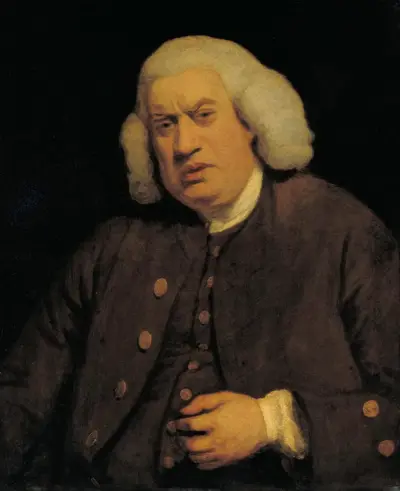
Samuel Johnson, often referred to as Dr Johnson, was an English writer who made lasting contributions to English literature as a poet, playwright, essayist, moralist, literary critic, biographer, editor, and lexicographer. Religiously, he was a devout Anglican, and politically a committed Tory. The Oxford Dictionary of National Biography describes Johnson as "arguably the most distinguished man of letters in English history". He is the subject of James Boswell's The Life of Samuel Johnson, described by Walter Jackson Bate as "the most famous single work of biographical art in the whole of literature".
