James W. Ford Quotes
... confusion and dangerous moods in the rank and file of the Negro people and utilizing their justified grievances as a weapon of opposition to the Administration’s war program.
The communists were so supportive of the war effort that they were often unconditional defenders of the Roosevelt Administration’s war program. Most communists suspended their advocacy of labor strikes and Black enfranchisement during the war because it would ultimately lead to the weakening of the Allied efforts against the Nazis. Programs such as the “March on Washington Movement” were seen as untimely and therefore subversive. For more communist criticism of attempts during this period to further civil rights see {599051}
James W. Ford, -1957*, Black leader, American Communist Party, Vice Presidential Candidate (American Communist Party), Criticism of the “March on Washington Movement”, “The Negro People Unite for Victory,” The Communist, July 1943
Sourced by: Eigen's Political and Historical Quotations

American Communist Party Newspaper. The communists were so supportive of the war effort that they were often unconditional defenders of the Roosevelt Administration’s war program. Most communists suspended their advocacy of labor strikes and Black enfranchisement during the war because it would ultimately lead to the weakening of the Allied efforts against the Nazis. Programs such as the “March on Washington Movement” were seen as untimely and therefore subversive and fascist. For more communist criticism of attempts during this period to further civil rights see {603312}

The racial inequality did cause a Black revolution in the 1960s. The arrival and influence of Martin Luther King, at the time Black revolution might have turned violent, and the willingness of a substantial number of whites to implement the Civil Rights revolution functioned as a safety valve so that there was substantial reform towards much more racial equality.


Johnson was the first Black man who won the heavyweight championship at a time when racism in America was rampant. Many whites referred to Jeffries as “The Great White Hope” who would take the champion back for the whites. He didn’t and was beaten badly.

This memo is yet another example of the racism and paranoia about Civil Rights within the FBI. The Director himself was a racist {620620} . Sullivan was reacting to the Martin Luther King Jr. “I Have a Dream” speech during the march on Washington just before. What made King so dangerous was that he was demanding equal rights for Black and he was very influential with the Black community. Therefore, in FBI logic at the time, King was a great danger to the United States. See {74219} for another example.


Davis was criticizing the civil rights protesters, who were protesting the U.S. Army’s discrimination of four Blacks at Fort Devens in April 1945. Even though Davis himself was Black, he, along with most communists believed that the international problem of Nazism should be treated first and foremost, and without interruption.


Connor turned out to have been of great assistance to the Civil Rights Movements. His red-neck, ignorant, virulent, irrational hatred and his position made him an iconic, living, hyperbole of the American Southern Racist.

A Black church had been bombed in Birmingham, Alabama among the general racial indignity visited upon the Blacks of that city. King’s conversation was not generally known until 2003 when the secretly recorded conversations of the Kennedy Presidency were released, transcribed and analyzed. Shortly after the conversation, JFK called five white leaders of Birmingham and upbraided them about the lack of progress in Birmingham.

Benjamin was the first African American general.

Kennedy was initially very opposed to a civil rights march on Washington and seemed very annoyed to the Blacks in attended. But when faced with the reality of the fact that the March was going to take place and he could not prevent it, he turned around and did everything he could do to protect the marchers and enable the historic event.


Scott was then the Special Advisor on Negro Affairs to the Secretary of War in the Woodrrow Wilson administration. Wilaon hs commited U. S. Troops to fight oversease to "make the world safe for democracy", but many blacks and whites also saw gross hypocricy in asking Negores to fight for a Jim Crow, segregated America. See the related quotation 644805. Scott was also the major aide to Booker T, Washington, one of the leading Negro educators but a very pliable man on equal rights for the Blacks. The problem for the administration was much greater than that of WWII where the president was seen as very sympathetic to Blacks while Wilson was himself a racist. And in WWII the fight against the Nazis was a fight agaisnt racial supremacy. So this quotation and Scott's role was very important to the administration.
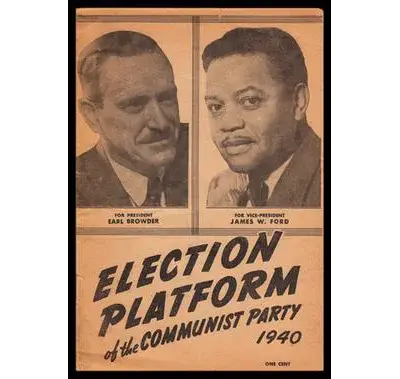
James W. “Jim” Ford was an activist and politician, the Vice-Presidential candidate for the Communist Party USA in 1932, 1936, and 1940. A party organizer born in Alabama and living in New York City, Ford was the first African American to run on a presidential ticket in the 20th century.
