Swami Vivekananda Quotes
Change is always in regard to something which does not change, or which changes relatively less.
Vivekananda, Swami. The Complete Works of Swami Vivekananda. Vol. 2, Advaita Ashrama, 1989, p. 76.


See Heraclitus {436440} for the ancient Greek exposition of this idea.


This statement is very revealing in that it illustrates the attitude of the establishment of most developing nations. Traditional change is OK as long as it is not does transformational—ie as long as it does not make any meaningful changes. But modernization requires transformational change; without it there is no major reform and all institutions and power structures remain in their positions.


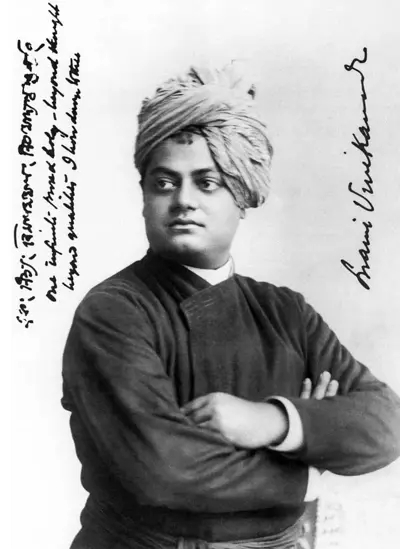
Swami Vivekananda, born Narendranath Datta (Bengali: [nɔrendronatʰ dɔto]), was an Indian Hindu monk. He was a chief disciple of the 19th-century Indian mystic Ramakrishna. He was a key figure in the introduction of the Indian philosophies of Vedanta and Yoga to the Western world, and is credited with raising interfaith awareness, bringing Hinduism to the status of a major world religion during the late 19th century. He was a major force in the contemporary Hindu reform movements in India, and contributed to the concept of nationalism in colonial India. Vivekananda founded the Ramakrishna Math and the Ramakrishna Mission. He is perhaps best known for his speech which began with the words "Sisters and brothers of America ...," in which he introduced Hinduism at the Parliament of the World's Religions in Chicago in 1893.
