John Paul Stevens Quotes
But I really think it's a very unfortunate part of our judicial system and I would feel much, much better if more states would really consider whether they think the benefits outweigh the very serious potential injustice, because in these cases the emotions are very, very high on both sides and to have stakes as high as you do in these cases, there is a special potential for error. We cannot ignore the fact that in recent years a disturbing number of inmates on death row have been exonerated.
Stevens, John Paul. Baze v. Rees, 553 U.S. 35, Supreme Court of the United States, 16 Apr. 2008, p. 86.


He was referring to exonerations for capital crimes like murder. He had written a book about a case where a man who was later proved innocent was reprieved only 5 days before his execution.


The Senator was referring to the large number of people who had been exonerated by DNA evidence while on Death Row.


More and more evidence had been mounting that innocent men had been mistakenly sentenced to death throughout the country and Texas executed more people than any other state.


Adopted by the original Edinburgh Review Magazine as its motto.

The exonerated based on the investigative work of some volunteer attorneys and law students. None of the miscarriages of justice were found or discovered by any law enforcement personnel, prosecutors, judges or officials of Texas. All the exonerated were released from jail where many had served decades for crimes they did not commit. 5 were released from Death Row—awaiting to be executed. Perry’s logic was that there was no problem because the 56 were released. For him, innocent people serving decades in Jail and sometimes waiting to be executed, did not constitute a problem. Of course, he assumed that the 56 cases of exhortation were the only cases of wrongful convictions in Texas. See {635340}.
Texas executes more people than the rest of the United States does. However, just before the debate an investigation disclosed 56 recent cases in Texas where the “criminals” were completely exonerated based on the work of some volunteer attorneys and law students. They were all released from jail where many had served decades for crimes they did not commit. 5 were released from Death Row—awaiting to be executed. See {635339}.


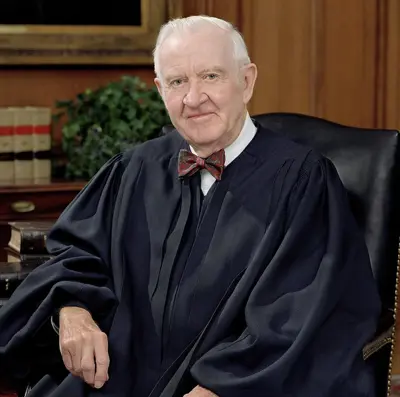
John Paul Stevens was an American lawyer and jurist who served as an associate justice of the United States Supreme Court from 1975 until his voluntary retirement in 2010. At the time of his retirement, he was the second-oldest-serving justice in the history of the court and the third-longest-serving justice. At the time of his death, he was the longest lived Supreme Court justice ever. His long tenure saw him write for the court on most issues of American law, including civil liberties, death penalty, government action and intellectual property. In cases involving presidents of the United States, he wrote for the court that they were to be held accountable under American law. A registered Republican when appointed who throughout his life identified as a conservative, Stevens was considered to have been on the liberal side of the court at the time of his retirement.
