Salman Khurshid Quotes
Business and politics have a wholesome and an unwholesome interface. You have to eliminate the unwholesome interface.
Khurshid, Salman. Address on Corporate Governance. Business Standard, Business Standard Private Ltd., 2012.

Mises is one of the very few economic conservatives who opposed companies getting involved with lobbying or politics in any way. He, like some others, saw the negative public effect that business produces when it does get deeply involved in politics, but he uniquely observed that the businesses themselves suffered as a result of the involvement in politics. Obviously very few business leaders of the 21st century agreed with Mises’ earlier views.


While New York City and a few other jurisdictions—states and local—have more stringent laws and ethical standards for politicians than does Congress and Federal Officials, but most have lower standards. In some of the jurisdictions judges can try cases and rule in favor of a company or wealthy individual who gave the judge the money to campaign with and get elected.

Virginia at the time had very lax political ethical laws and regulations for politicians and in that year, both the Republican Governor and the Republican Attorney General had accepted large gifts from businessmen of the state which in other states would have been considered as bribes and be illegal. The rules in Virginia were so lax, that expensive gifts were given to members of politician’s family. In one case that year, a businessman paid for the Governor’s daughter’s expensive wedding. With both houses of the state legislature also in Republican hands, there was no oversight or investigations. It was only though the efforts of the press that the facts emerged. Although in 2013 it was Republicans who were corrupt, the same lax rules had prevailed for years and when the Democrats were in power the Democrats made no effort to tighten the ethics laws and rules. Corruption and denial of its existence characterized Virginia at that time. In 2013, the Republican speaker of the House actually had the temerity to state that since Virginia politicians were so honest, ethical rules and laws were not needed. See {633807}.


President Andrew Jackson was the first President who went after them. The mechanism of these men has been bribes, much more common in early and middle America than today where campaign contributions are a legalized way of the wealthy having more influence on the control of the country. The other way was by the control of the money supply, the markets and banking. Jackson would not go along with allowing a small number of very wealthy bankers to control the monetary policy of the country. In modern times, there are a number of left and right wingers who see the private Federal Reserve Bank and its secrecy as an example of what Roosevelt was referring to,


Chomsky sees this as a problem. Many others see it as a virtue that government agencies receive current information from companies and that there is an exchange of personnel where company officials bring their experience to assist government and corporations benefit from having executives who had some government experience.


Trump often used the phrase "Drain the swamp" in his campaigning to mean get ride of the establishment figures who had, for the most part, dominated politics, for decades. When he was elected, he had to appoint a cabinet, but when he did so, it was almost exclusivly made up of people who had been a part of the political and corporate establishment -- the swamp.

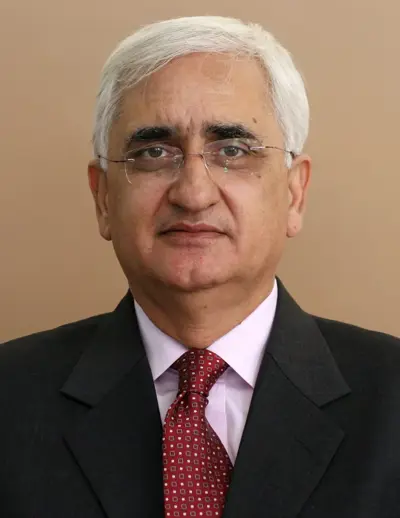
Salman Khurshid Alam Khan is an Indian politician, designated senior advocate, eminent author and a law teacher. He was the Cabinet Minister of the Ministry of External Affairs. He belongs to the Indian National Congress. He is a lawyer, and a writer who has been elected from Farrukhabad Lok Sabha constituency in the General Election of 2009. He belongs to the Farrukhabad area. Prior to this he was elected to the 10th Lok Sabha (1991–1996) from the Farrukhabad Lok Sabha constituency. He became the Union Deputy Minister of Commerce in June 1991, and later became the Union Minister of State for External Affairs (Jan. 1993 – June 1996). He started his political career in 1981 as an Officer on Special Duty in the Prime Minister's Office (PMO) under the prime ministership of Indira Gandhi.
