Rumi Quotes
Be helpless, dumbfounded, Unable to say yes or no. Then a stretcher will come from grace to gather us up. We are too dull-eyed to see that beauty. If we say we can, we’re lying. If we say No, we don’t see it, That No will behead us And shut tight our window onto spirit. So let us rather not be sure of anything, Beside ourselves, and only that, so Miraculous beings come running to help. Crazed, lying in a zero circle, mute, We shall be saying finally, With tremendous eloquence, Lead us. When we have totally surrendered to that beauty, We shall be a mighty kindness.
Rumi, Jalal al-Din. The Essential Rumi. Translated by Coleman Barks, HarperSanFrancisco, 1995, pp. 9-10.


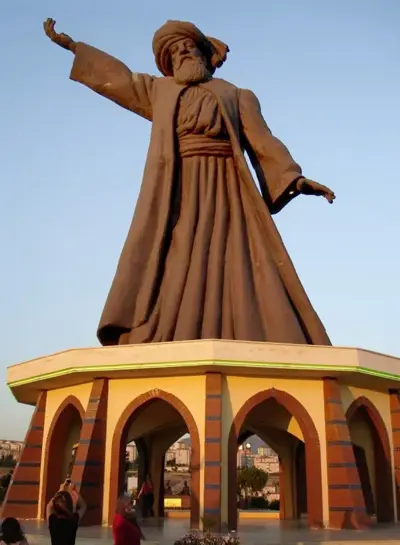
Jalāl ad-Dīn Mohammad Rūmī (Persian: جلالالدین محمد رومی), also known as Jalāl ad-Dīn Mohammad Balkhī (جلالالدین محمد بلخى), Mevlânâ/Mowlānā (مولانا, "our master"), Mevlevî/Mawlawī (مولوی, "my master"), and more popularly simply as Rumi, was a 13th-century Persian poet, Hanafi faqih, Islamic scholar, Maturidi theologian, and Sufi mystic originally from Greater Khorasan in Greater Iran. Rumi's influence transcends national borders and ethnic divisions: Iranians, Tajiks, Turks, Greeks, Pashtuns, other Central Asian Muslims, and the Muslims of the Indian subcontinent have greatly appreciated his spiritual legacy for the past seven centuries. His poems have been widely translated into many of the world's languages and transposed into various formats. Rumi has been described as the "most popular poet" and the "best selling poet" in the United States.
