Aristotle Quotes
Bad men are full of repentance.
Aristotle. Nicomachean Ethics. Translated by W.D. Ross, Clarendon Press, 1908, 1166b.


The President refused since Lyon himself had not apologized and asked for forgiveness.


The Senator had been illegally frequenting prostitutes and was a regular customer of an infamous DC Madam. The reason this quotation is noteworthy is that it is a stunning example of moral hypocrisy in politics. Vitter ran as a very conservative politician who placed traditional Christian and family values at the forefront of his political philosophy. When his behavior was made public there were calls for his resignation. He refused and instead gave this statement. However, he had been elected to replace Robert Livingston who had been the Speaker of the House but had resigned when he was caught frequenting prostitutes. Vitter’s hypocrisy was all the more hypocritical as he had demanded the resignation of President William Clinton who had engaged in adulterous sex while in office. When he was running for office and his opponent complained that Vitter had been frequenting prostitutes, Vitter said that the accusation was absolutely and completely untrue" and that it was "just crass Louisiana politics”. This reinforced the hypocrisy in that Vitter claimed that one of Clinton’s failings was that he lied about his adulterous affair, while Vitter not only lied, but did so the public for purposes of getting elected. And just a few months before this statement, Vitter proclaimed the importance of abstinence for teenagers and faithfulness for adults. See {625896}.


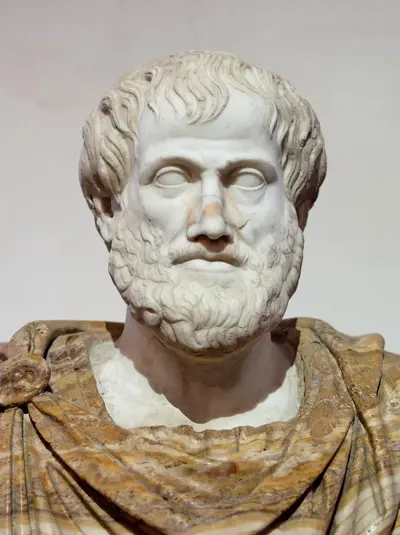
Aristotle (/ærɪˈstɒtəl/; Greek: Ἀριστοτέλης Aristotélēs, pronounced [aristotélɛːs]; 384–322 BC) was a Greek philosopher and polymath during the Classical period in Ancient Greece. Taught by Plato, he was the founder of the Lyceum, the Peripatetic school of philosophy, and the Aristotelian tradition. His writings cover many subjects including physics, biology, zoology, metaphysics, logic, ethics, aesthetics, poetry, theatre, music, rhetoric, psychology, linguistics, economics, politics, meteorology, geology and government. Aristotle provided a complex synthesis of the various philosophies existing prior to him. It was above all from his teachings that the West inherited its intellectual lexicon, as well as problems and methods of inquiry. As a result, his philosophy has exerted a unique influence on almost every form of knowledge in the West and it continues to be a subject of contemporary philosophical discussion.
