William Petty Quotes
As for Physicians, it is not hard by the help of the observations which have been lately made upon the Bills of Mortality, to know how many are sick in London by the number of them that dye, and by the proportions of the City to find out the same of the Country; and by both, by the advice of the learned College of that Faculty to calculate how many Physicians were requisite for the whole Nation; and consequently, how many Students in that are art to permit and encourage; and lastly, having calculated these numbers, to adopt a proportion of Chyrurgeons [doctors], Apothecaries, and Nurses to them, and so by the whole to cut off and extinguish that infinite swarm of vain pretenders unto, and abusers of that God-like Faculty
This is one of the first organized proposals to do manpower planning—in this case in the medical field. However, the purpose was not to assure an adequate supply of health personnel, but to have a guide to crack down on all the mountebanks, frauds and others who used health services as a vehicle for their deceptions.
William Petty, 1623-1687, English Economist & Demographer, A Treatise of Taxes & Contributions, 1662
Sourced by: Eigen's Political and Historical Quotations

There are some conservative economists and businessmen who believe that it is desirable to have some unemployment as a bulwark against inflation. If there are people without jobs, they will hold the general wage rates down.


At the height of the Great Depression there were conservative politicians who were opposed to any form of relief or assistance for those in need. Their grounds were that if people got something for nothing, they would lose their moral compass—they would be demoralized. Lady Mosley, who was a member of one of the wealthiest families in England, embarrassed the opposition Conservatives by observing that the upper classes have gotten something for nothing for years and the moral base was still intact.


She was one of the first female physicians in England. However, she could not study there or sit for her examinations. She trained in the Scotland, Ireland and Swizerland where she earned her medical degree.


This is not a common quotation from Thoreau. The great man for whom the establishment had so much respect had a very anti-capitalist streak. His view is that the employer will generally never pay his laborers a fair wage. Instead he will pay the laborer the lowest rate for which he can obtain the laborers services. If the laborer generates added value for his wage, the employer is in a zero sum game with the laborer. If part of the added value—the profit is paid to the laborer, the employer does not have it for himself (or his stockholders). In most cases, the laborer is forced to work for his and his family’s subsistence. This theory argues that they only way the laborer will get a fair wage is if there is a labor shortage (assuming no government laws or union pressure is in the picture. Many capitalists argue that a “fair” wage is what a free man is willing to work for and a free employer is willing to pay. So economics is like politics in general with respect to fairness—there is no universally accepted definition of what is fair.


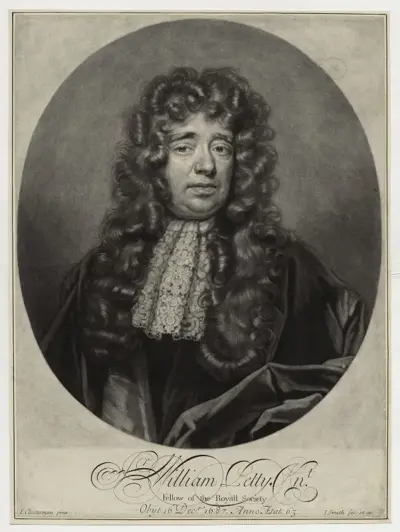
Sir William Petty FRS was an English economist, physician, scientist and philosopher. He first became prominent serving Oliver Cromwell and the Commonwealth in Ireland. He developed efficient methods to survey the land that was to be confiscated and given to Cromwell's soldiers. He also remained a significant figure under King Charles II and King James II, as did many others who had served Cromwell.
