William A. Dembski Quotes
As far as design theorists are concerned, theistic evolution is American evangelicalism's ill-conceived accommodation to Darwinism .
Dembski, William A. Intelligent Design: The Bridge Between Science and Theology. InterVarsity Press, 1999, p. 110.


There are many scientists who disagree with Johnson’s very unusual logic. They point out that it is certainly possible that God initially did not have had humans in minds, and when they evolved, decided that they were worthy of salvation history and then interfered to the extent of a virgin birth. Others would point out that just because man cannot exactly foresee the exact future pattern of evolution, does not men that a Supreme Being could not have initiated the mechanism that he/she knew would result in salvation history. The Pope and the Catholic Church see no inconsistency between Darwinism and the salvation history. Then there are those non-Christians who do not believe that God ever did introduce salvation and there are many more of them than there are Christians. Then, it is possible that God just set things in motion and had more important things then micromanaging evolution on our one planet in a universe of billions of billions. Last there are those who do not believe that there is or has been a God. Of course there is the possibility that Johnson is right, and religiously he may be, but that is not subject to scientific analysis.
Ms. Holloway had led the majority of the board that had voted to revise the education standards of Kansas to exclude evolution. She was defeated in the Republican primary election afterward. See Sue Gamble {602752}
This quotation is a good example of what a substantial number of Americans believe and the classic errors they make in acting on their views. The vast majority of the religions in America have no conflict with evolution. To them evolution is the method that God chose to create the life on earth. Some fundamentalists take the Old Testament versions of the creation of the earth and man (there are 2 of them that conflict) literally by which they conclude that the earth is 6,000 years old or so. In reality, the earth is over 10 Billlion years old but the scientific evidence that proves this as well as evolution via natural selection is almost always not known to them. It is not as if they have studied it an rejected evolution. Almost all have never studied it. As a result they think that the word “Theory” means an unproven hypothesis which is the lay, non scientific meaning of the word. But in science, a theory is large set of related proven laws or principles, that has been tested over and over again and for which there has NEVER been a counterexample proven. A theory does not explain everything in the area and additional hypotheses are constantly being tested and if they stand up are added to the theory. And there are areas that are not explained by a theory, and these may or may not be in the future, but no theory does or can explain everything. Brattin, who sadly has never been educated about the science of biology, believes that it is a scientific theory is a “belief structure” like a religion. However, to qualify as part of an established scientific theory the statements must have been subjected to demonstrative proof, usually by many different scientists typically using many different methods. And these results must be replicated over and over again. No religion can be proved the way a scientific theory can be and that should not surprise anyone as religion is in the domain of faith where science has not the methodology to validate or invalidate people’s religious beliefs. Likewise, religion has not the methodology to prove or disprove science not should it be expected to. Many scientists are religious and many are not. Many religious people are scientists and many are not. They have little to do with each other.


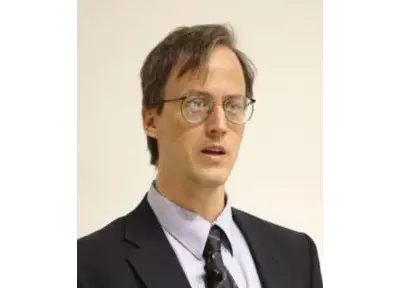
William Albert "Bill" Dembski is an American mathematician, philosopher and theologian. He was a prominent proponent of intelligent design (ID) pseudoscience, specifically the concept of specified complexity, and was a senior fellow of the Discovery Institute's Center for Science and Culture (CSC). On September 23, 2016 he officially retired from intelligent design, resigning all his "formal associations with the ID community, including [his] Discovery Institute fellowship of 20 years."
