Joseph Smith Jr. Quotes
And now, verily I say unto you concerning the ... law of the land which is constitutional, supporting that principle of freedom in maintaining rights and privileges, [that it] belongs to all mankind, and is justifiable before me. Therefore, I, the Lord, justify you ... in befriending that law which is the constitutional law of the land.
This is a remarkable quotation. Because of the issue of plural marriage, many Americans regarded the early Mormons as having no respect for the country or its laws. However, as this quotation shows, the Mormon leader, prophet and founder specifically commanded his people to not only support the United States law but specifically mentions The Constitution. He told his followers that God approves of the United States constitution and states that it is in a sense universal, belonging to all mankind. There is no other religious founder who so thoroughly validated a national constitution and system in the history of the world. Yet he was assassinated and after his death, the United States Government was almost in a full scale war with the Mormons. There is still a vestige of anti-Mormonism in the United States among some Christian Fundamentalists. Yet the Mormon church has been a thoroughly American church, historically, conceptually, and philosophically It has even shared some of the American historical errors such as its sexism and discriminatory rules and view of Blacks. The latter has been remedied {625268} as the rest of America has changed, and the discriminatory role of women is very traditional and is shared with most other Christian fundamentalists and orthodox Jews.
Joseph Smith, Jr., 1805–1844, Prophet & Founder of the Mormon Church, D&C 98:4–6
Sourced by: Eigen's Political and Historical Quotations

This was a momentous change of doctrine for the Mormon Church. Prior to this revelation, Mormons would very actively convert and accept Blacks as members but would not ordain a Black, This doctrine had made Mormons, who were themselves persecuted in America, more acceptable—especially in the Southern States. However, it had been a source of great political and intellectual embarrassment to the Church until Kimball resolved the problem with this declaration.

He had been a Congressman before assuming the Presidency. Civil rights was a major subject of debate after the Civil War. One major issue was that of citizenship itself. Many contended that Americans were citizens of a state and dependant on the state for the protection of civil rights. However, the extent to which the Federal government could and should be the guarantor of citizenship issues was in dispute. Today with the issue settled in favor of Federal preeminence, it is hard to realize that this was very unsettled at one point in history. Garfield was one of those leading the effort for more Federal involvement and control.


This is a very important political, historical, and philosophical quotation. This is a view that is very common amongst many Americans—especially those who are religious. As a factual matter, it is not clear that ALL the founding fathers personally believed in the creator--God. All the views have never been discerned. However it is almost certain that the majority of the Founders so believed. The complication with taking this viewpoint too literally is that while our rights may have come from God, it is men who determined exactly what rights would be enumerated on our constitution. For example. the original draft of the Constitution did not include, the right to a free press, the right of due process, the right of being free from religious compulsion and others. Yet it passed. Then other men and women wanted more rights added and the Constitution was ratified on condition that the Bill or Rights would be incorporated as the first 10 amendments. There were other rights that were not explicitly mentioned. For example, there is no right to an education mentioned in the Constitution or any of the amendments. Blacks had no rights until additional amendments were passed. And later there was an amendment that denied Americans the right to drink alcohol. Then another that gave the rights back. There are rights that other nations have which we do not—ie the right to medical care. Which if these did God grant and which, not? So even if we assume that every one of the founding fathers not only believed in God, but believed the rights were all God given, we would still be in the practical dilemma of having to specify the language of each right and always to, by amendment, adding additional rights or modifying or even deleting older rights. Many believe that Americans were divinely inspired when we added (or changed) rights. Others, not. However, regardless, we must go through the same procedures of enumerating American rights and amending the constitution. So the process is the same for both those who believe that our rights come from God and those who do not. To change rights, we need the action of Americans divinely inspired or otherwise, but they can and have been changed. For example, before 1963 Americans did not have a right to use birth control devices. After the Supreme Court Griswald v. Conn. We did and now have a right to use birth control devices. The mode that rights are manifested, defined, enumerated and implemented is a political one—one that in our American system allows us all to implement that system whether or not we believe that our rights come from our Creator.
The Mormons were the most persecuted religion in American History and have a keen appreciation for the importance of upholding Constitutional Rights.


This constitution, 13 years later, became the basis for the national Batavian Constitution.


The choice of non-capitalization of the word “god” was Jefferson’s and is retained herein. This quotation is one of the most important in American history because it set the boundary for when it was proper for government to legislate personal behavior. For Jefferson, legislation was only justified if the behavior damged other people economically or physicly. Moral, religious, ethical or cultural affects were not sufficient to interfere with other people's freedom. The quotation was initially given to argue against a state etablished church and blasphemy laws and has been used in arguments even into the 21st century debate over gay marriage.

Many New Yorkers and others felt that since the attack on the World Trade Center was made in the name of Islam, the mosque and commuity center should be built in another location further from Ground Zero. Ellison was debating someone who argued that the Mosque should not be built so that sensitivity can be shown for those New Yorkers who lost relatives and friends in the attack of September 11. Rather than insist on their Constitutional rights, the Muslim leadership of the project, moved the location somewhat further away from Ground Zero.

It is ironic that Pakistan, the creation of Jinnah’s efforts, has to a great extent adopted Sharia (Islamic Law) resulting in severe curtailment of freedom of speech and thought. Professors languish in jail for not teaching the history of Muhammed in the orthodox way, people are sentenced to death for what the local mullahs regard as blasphemy—results which from Jinnah’s point of view were terrible.


After being castigated by the Pope, Lameddais broke with the Church and concentrated on publishing and politics.

There was extensive persecution of Mormons with mobs denouncing them and attacking Mormon facilities and people often with the support of the government officials who were charged with protecting people and maintaining law and order.

1st Earl Baldwin of Bewdley

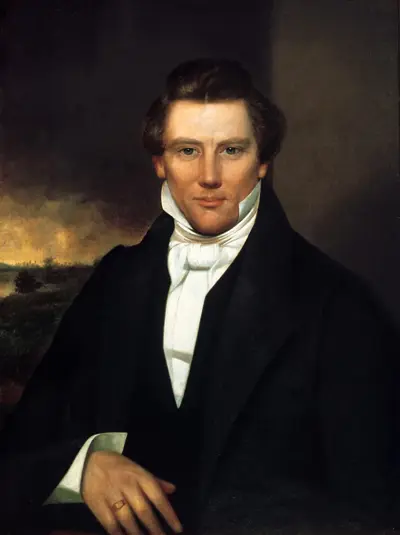
- Born: December 23, 1805
- Died: June 27, 1844
- Nationality: American
- Profession: Religious Leader
Joseph Smith, Jr. was an American religious leader and founder of Mormonism and the Latter Day Saint movement. When he was twenty-four, Smith published the Book of Mormon. By the time of his death fourteen years later, he had attracted tens of thousands of followers and founded a religious culture that continues to the present.
