Soren Kierkegaard Quotes
And if something should be found, particularly in the first part of the dissertation, that one is generally not accustomed to come across in scholarly writings, the reader must forgive my jocundity, just as I, in order to lighten the burden, sometimes sing at my work.
Kierkegaard, Søren. The Concept of Irony, with Continual Reference to Socrates. Edited and translated by Howard V. Hong and Edna H. Hong, Princeton University Press, 1989, p. 8.


This quotation illustrates the problem the politician and citizens have in trying to understand scientific issues. Most fields are amendable to learning much about by reading professional articles. Laymen can read legal opinions and lean much from them. Politicians can read articles about public opinion or a new form insurance policy. But it is generally impossible for the non scientifically trained person to even read much of the literature to try and learn more. This is why without scientific literacy, citizens and politicians alike will have great difficulty in integrating new scientific advances in our society. In the last 50 years much of economics and financing have reached the same state as the sciences. Officials who are supposed to regulate areas cannot understand the new developments of what they are trying to regulate.


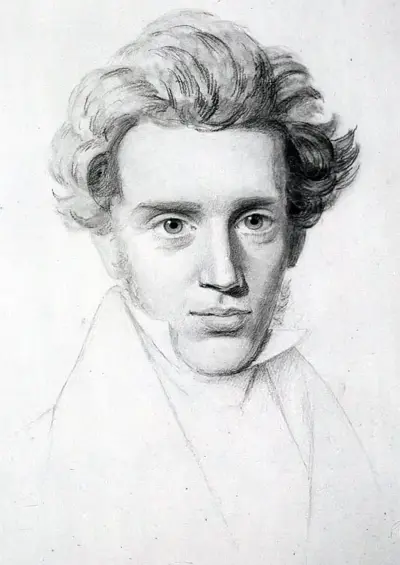
Søren Aabye Kierkegaard was a Danish philosopher, theologian, poet, social critic, and religious author who is widely considered to be the first existentialist philosopher. He wrote critical texts on organized religion, Christendom, morality, ethics, psychology, and the philosophy of religion, displaying a fondness for metaphor, irony, and parables. Much of his philosophical work deals with the issues of how one lives as a "single individual", giving priority to concrete human reality over abstract thinking and highlighting the importance of personal choice and commitment. He was against literary critics who defined idealist intellectuals and philosophers of his time, and thought that Swedenborg, Hegel, Fichte, Schelling, Schlegel, and Hans Christian Andersen were all "understood" far too quickly by "scholars".
