Juvenal Quotes
An excess of hoarded wealth is the death of many.
Juvenal. Juvenal and Persius. Translated by G. G. Ramsay, Harvard University Press, 1918, Satire 10, lines 12-13.


President Theodore Roosevelt referred to the same groups similarly. See {638453} and {639956}.


In modern America, there are two political views of this notion. The one held by a small majority of the population is Trenchard’s quotation taken literally. Their view is that there if the is no way to maintain liberty if there is too wide a gap between the rich and the rest of the population. The second variant, held by many conservatives limits the equality to equality of opportunity. They are loathe to take any position that says that any gap between the rich and the remainder of the citizens might be too large. They would particularly disagree with the first sentence of another Trenchard quotation, {627024}.


The same greatest issue was still before the people a century later. See {633217} , {635104} & {630538}.

See {625339} and {622808} for similar conservative views.


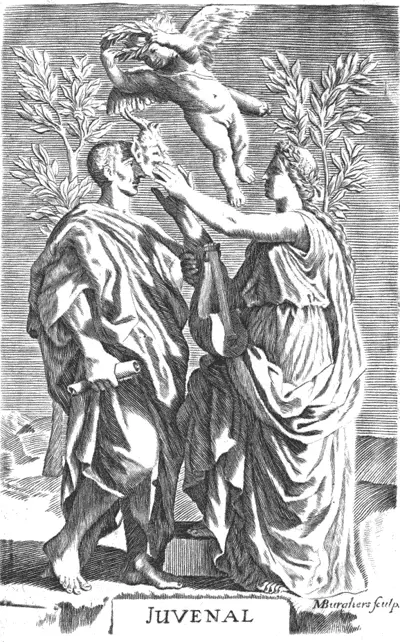
Decimus Junius Juvenalis (Latin: [ˈdɛkɪmʊs ˈjuːniʊs jʊwɛˈnaːlɪs]), known in English as Juvenal (/ˈdʒuːvənəl/ JOO-vən-əl), was a Roman poet active in the late first and early second century AD. He is the author of the collection of satirical poems known as the Satires. The details of the author's life are unclear, although references within his text to known persons of the late first and early second centuries AD fix his earliest date of composition. One recent scholar argues that his first book was published in 100 or 101. Because of a reference to a recent political figure, his fifth and final surviving book must date from after 127.
